LHN · Square Counterflow Cooling Tower · 80–1,000 m³/h

Space is tight. Outlet temperature must stay stable.
— Choose the LHN Square Counterflow Tower

180° counterflow heat exchange delivers a smaller footprint than crossflow towers at the same capacity. Single central inlet minimises pipework and downtime. Outlet temperature tracks wet-bulb temperature — precision processes stay in control.

Flow 80–1,000 m³/h Counterflow 180° Head Loss 40–55 kPa FRP Shell 15–20 yrs
Common Plant Challenges

Site constraints keep tightening — cooling demand keeps growing

When expanding production or upgrading process lines, plants typically face one of three field constraints. If any of these sounds familiar, the LHN should be your first evaluation.

≈ 0

Installation footprint is already locked

Rooftop equipment decks, building corners, legacy equipment zones, dense pipe corridors — the space available for a new cooling tower is effectively zero. The LHN's compact square structure fits greater cooling capacity into the same floor area.

±2–3 °C

Every degree of temperature swing costs yield

Fine chemicals, electronics, and semiconductor processes are highly sensitive to cooling water temperature fluctuations. During peak summer heat, even a few degrees of outlet temperature rise can trigger equipment alarms and force production lines to derate. The LHN's counterflow design delivers more stable outlet temperatures within a constrained footprint.

1–3 wks

Existing pipework cannot be significantly rerouted

Existing pipes, steelwork, cable trays, and equipment bases are already fixed. The LHN's single central inlet concentrates pipework at one point — even sites with severely restricted pipe space can complete installation without disrupting adjacent equipment.

LHN Core Advantages

Three engineering problems. Three LHN solutions.

01

Compact square structure — more cooling capacity in the same footprint

The LHN uses 180° counterflow heat exchange: air enters from the bottom and rises vertically through the fill media, while water falls vertically from top nozzles — the two streams in full counter-directional contact. This geometry delivers higher thermal efficiency, and at equivalent flow rates the plan-view footprint is significantly smaller than a crossflow tower.

For the plant, the result is straightforward: no foundation enlargement, no equipment zone re-planning, and a cooling system upgrade completed within the existing space.

Same flow rateNoticeably smaller footprint than crossflow — no foundation expansion required
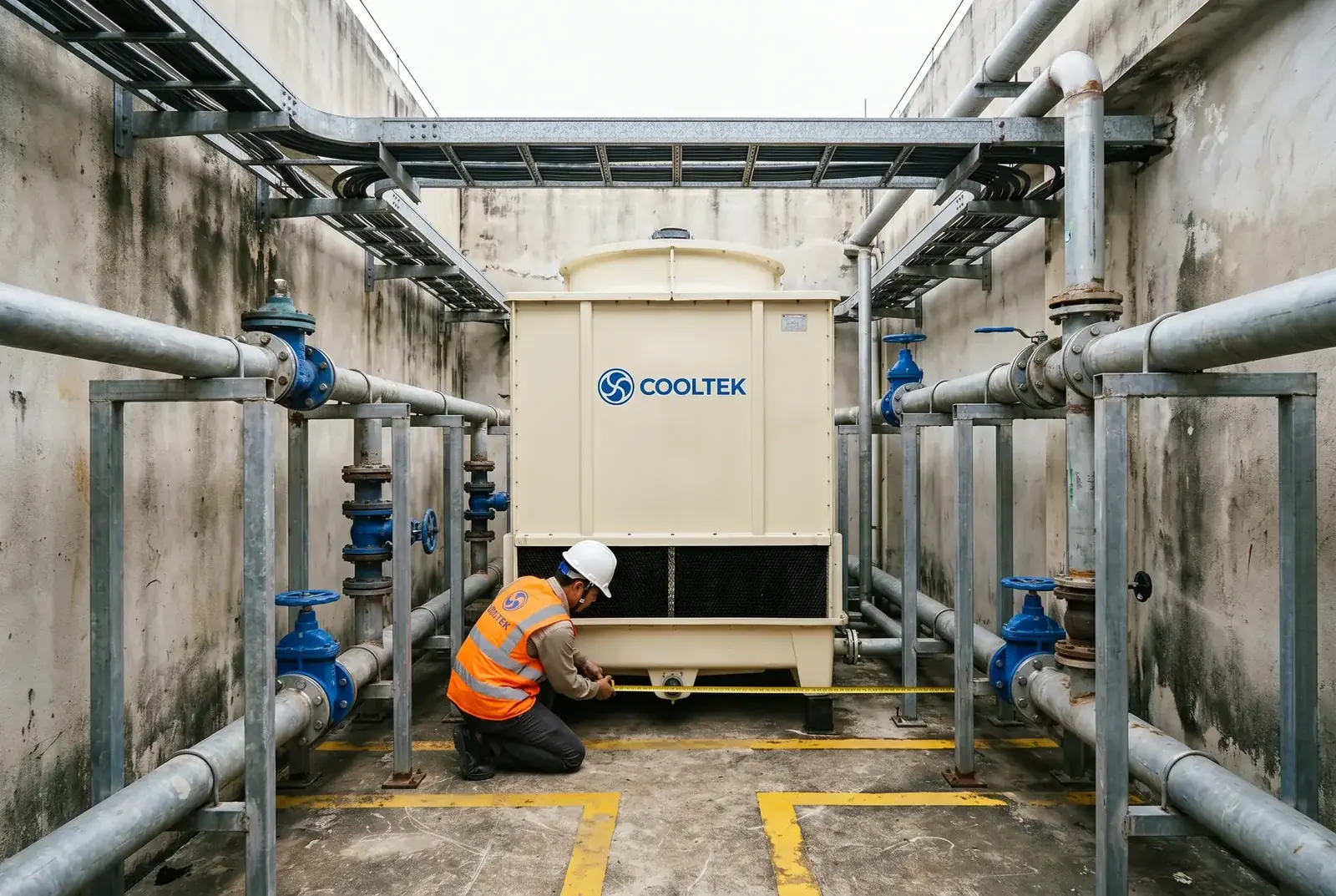
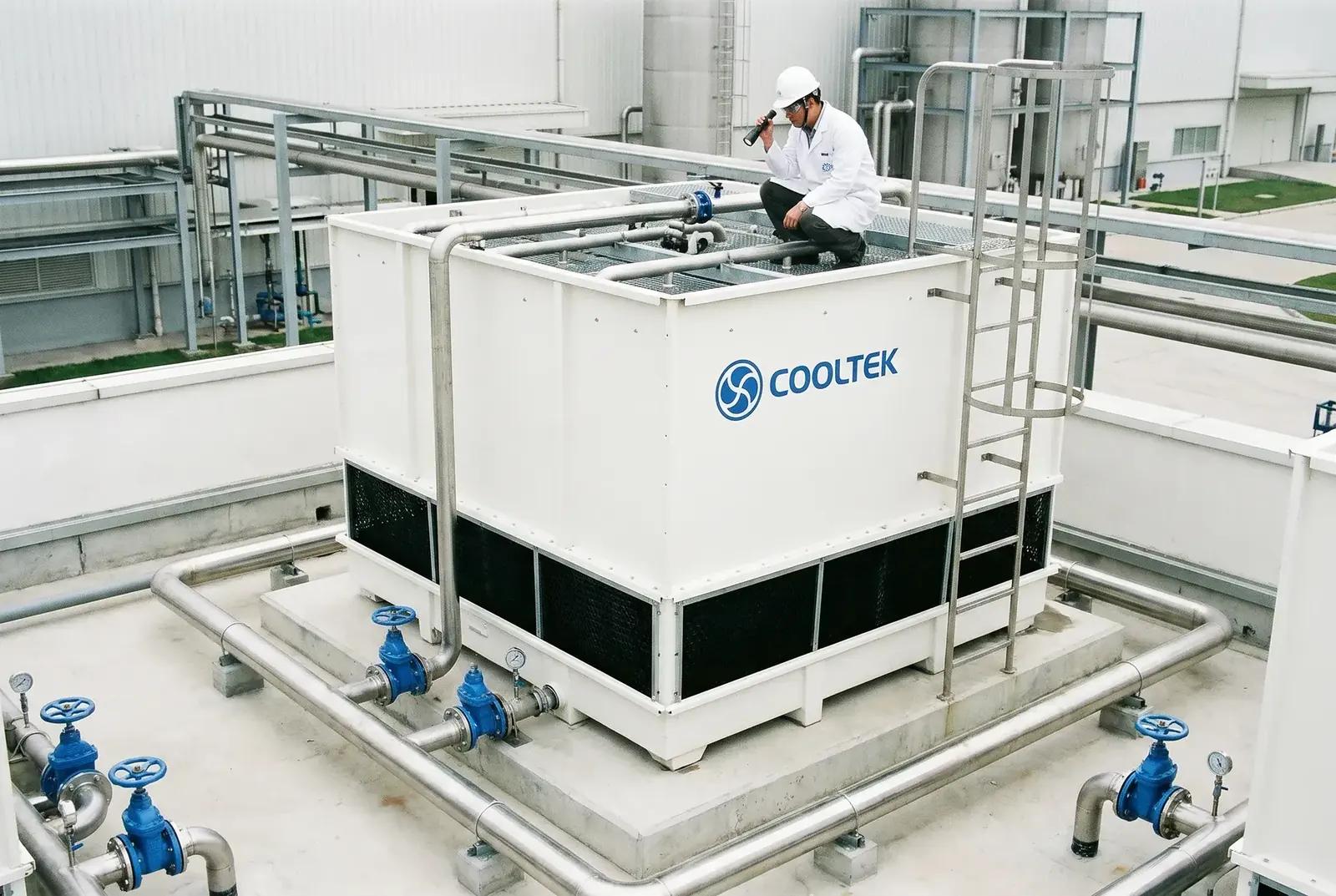
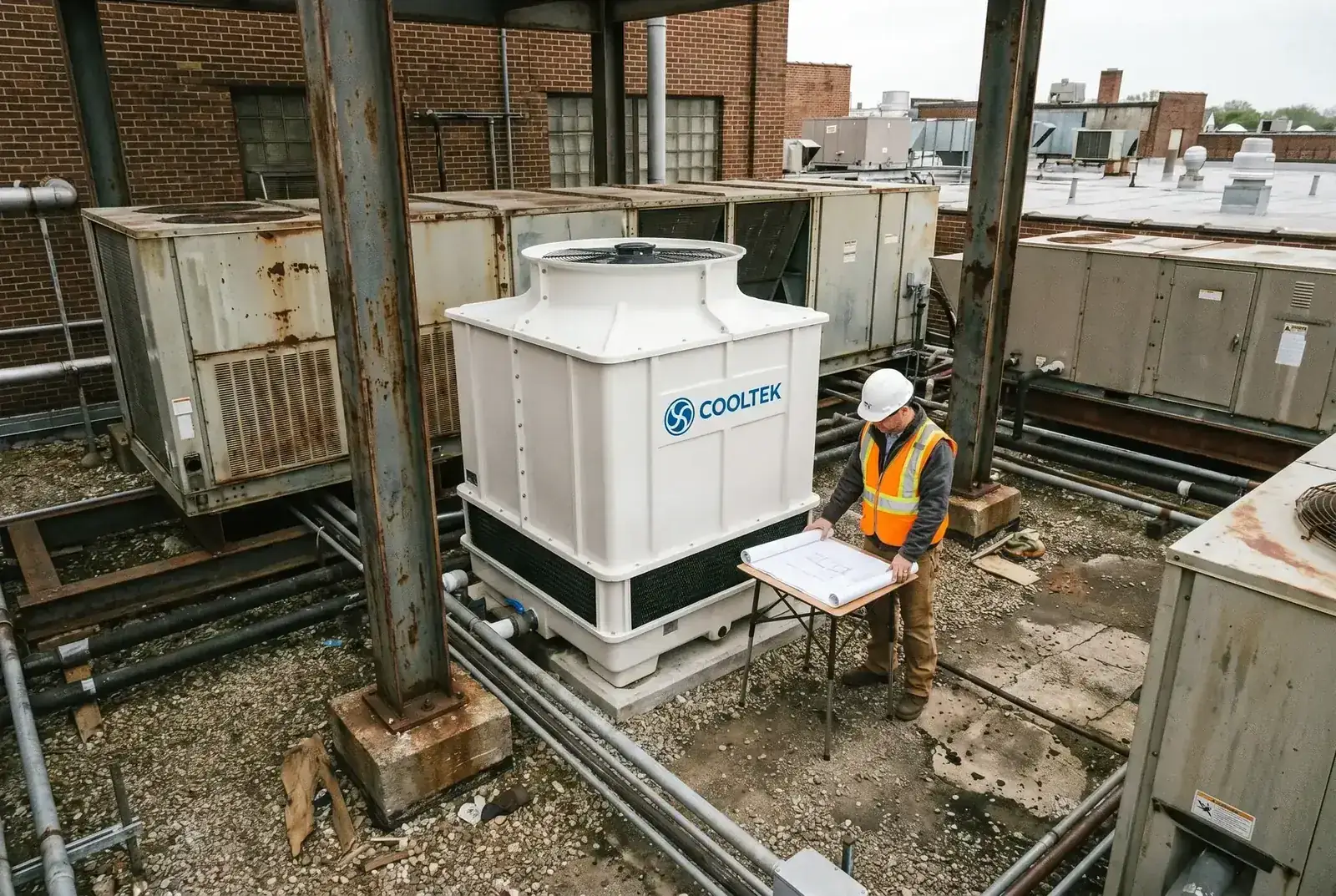
COOLTEK LHN square cooling tower installed in a confined rooftop space
Fig. 1 — LHN compact square structure installed in a pipe-dense, space-constrained site without altering the existing foundation layout.
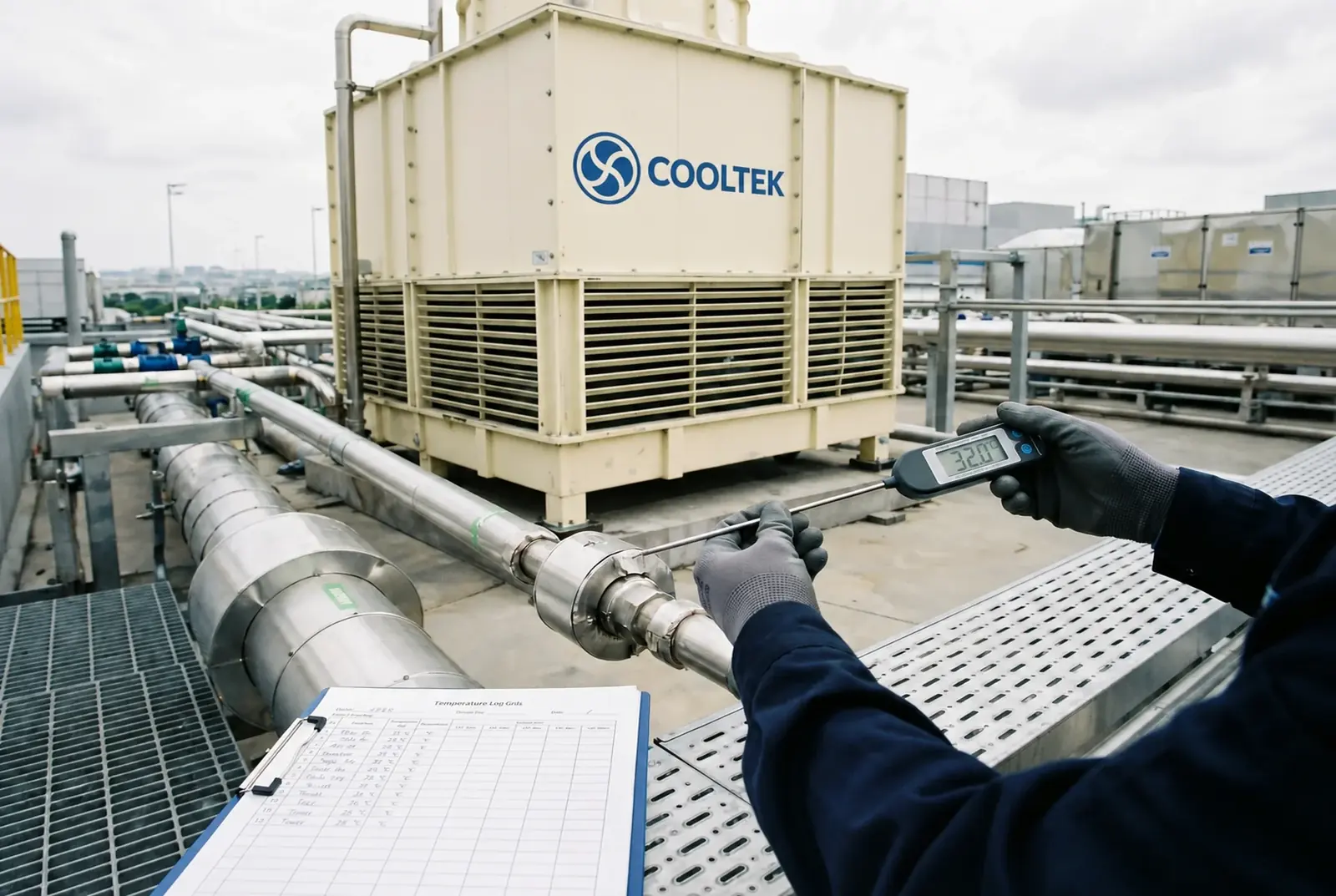
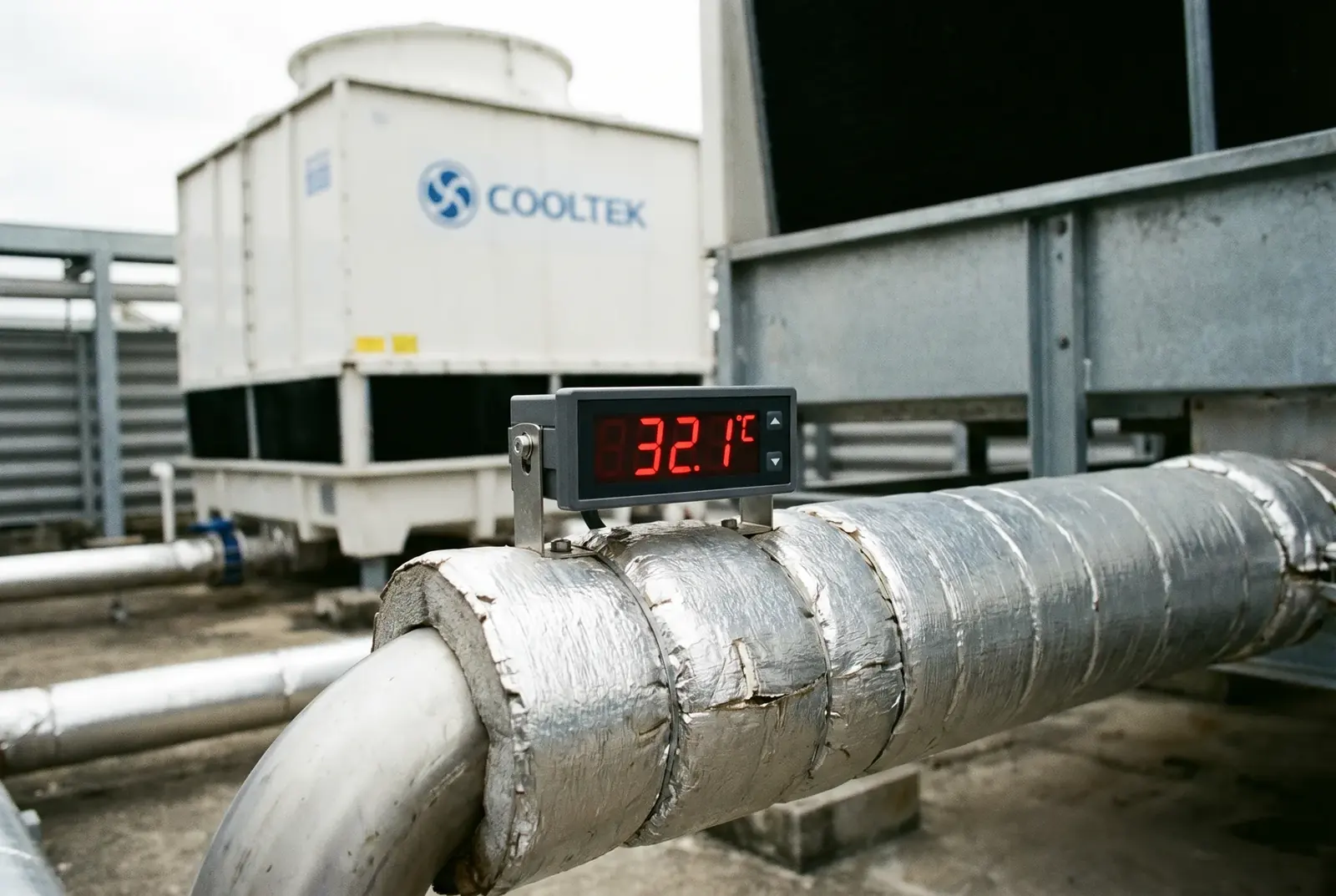
Technician measuring outlet water temperature at a COOLTEK LHN cooling tower
Fig. 2 — Outlet temperature measured at 32.0°C, consistent with design conditions. Outlet temperature stably tracks local wet-bulb temperature.
02

Counterflow heat exchange — more stable outlet temperature

The thermal efficiency advantage of a counterflow tower comes from the physics of fully counter-directional air-water contact. Fixed nozzles distribute circulating water evenly across the fill surface, creating a sustained temperature-differential driving force with the rising air stream — keeping outlet temperature closely and consistently tracking the local wet-bulb temperature.

For the plant, this means: outlet temperature is far less prone to sharp fluctuations during peak summer heat, equipment alarms are reduced, product yield is more predictable, and the risk of unplanned shutdowns is significantly lower.

Approach 3–5°COutlet temperature stably tracks wet-bulb — lower fluctuation than crossflow towers
03

Single central inlet — less pipework, less downtime, less risk

The LHN uses a single central inlet: the main pipe connects directly into the centre of the tower body, eliminating the need for symmetrical dual-sided branch piping. Compared to the multi-point inlet arrangements of crossflow towers, on-site pipework modification is substantially reduced.

The result: shorter construction schedules, lower installation costs, and better adaptability to existing pipe environments. Projects with severely restricted pipe space can proceed without affecting adjacent equipment operation.

Single central inletDN125–DN400, no dual-sided branches — minimum pipework modification
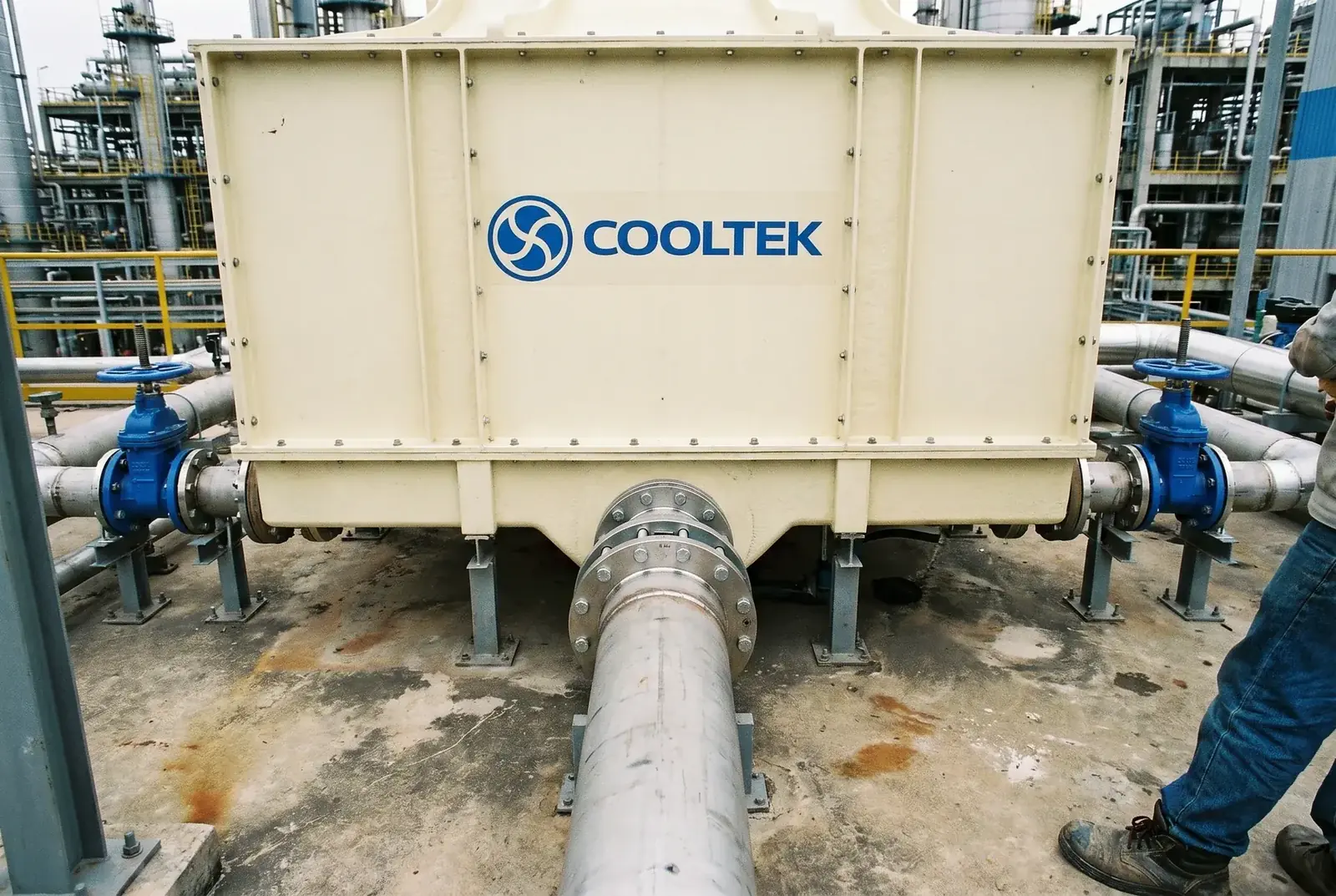
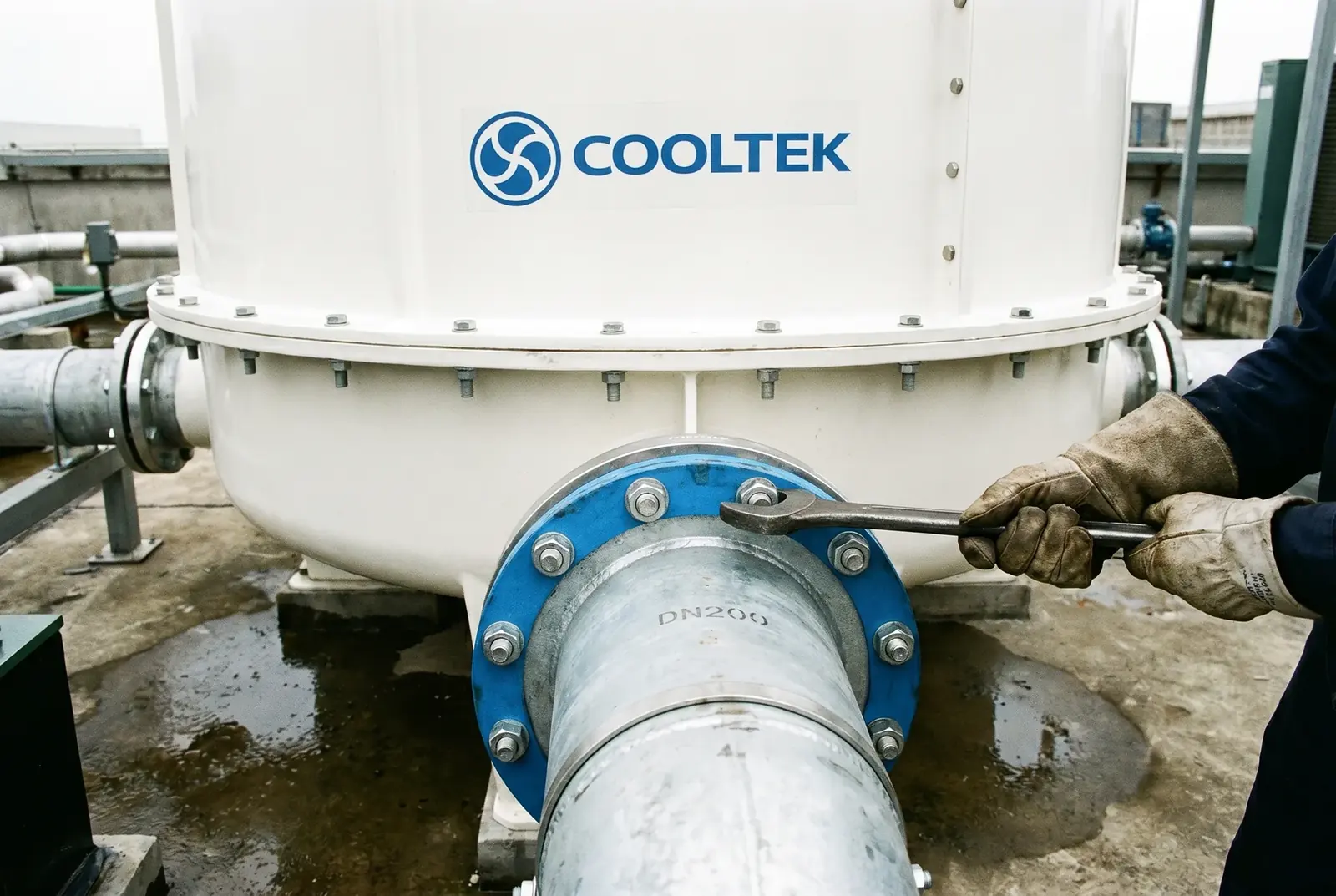
COOLTEK LHN cooling tower single central inlet flange connection
Fig. 3 — LHN single central inlet connection. Main pipe connects directly to the tower centre — no dual-sided branch piping required.
Quick Selection

LHN Series — All 16 Models at a Glance

16 models — match by flow rate or installation footprint

Standard design conditions: inlet 37 °C, outlet 32 °C, wet-bulb 27 °C, atmospheric pressure 99.4 kPa.

Model Flow (m³/h) Footprint L×W (mm) Height (mm) Fan Dia. (mm) Motor (kW) Dry Weight (kg) Inlet/Outlet (DN)
LHN-80802,000×2,0004,2501,5002.2950125
LHN-1001002,250×2,2504,2501,8004.01,050125
LHN-1251252,500×2,5004,2502,1005.51,250150
LHN-1501502,750×2,7504,4502,1005.51,420150
LHN-1751753,000×3,0004,4502,1007.51,600150
LHN-2002003,250×3,2504,4502,4007.51,750200
LHN-2502503,500×3,5004,4502,85011.02,150200
LHN-3003003,750×3,7504,9003,20015.02,620250
LHN-3503504,000×4,0005,0003,20015.02,950250
LHN-4004004,500×4,5005,0003,20015.03,520250
LHN-4504504,800×4,8005,0003,20015.03,810300
LHN-5005005,000×5,0005,2503,70015.04,150300
LHN-6006005,250×5,2505,7703,70018.04,680350
LHN-7007005,500×5,5005,7704,05018.55,460350
LHN-8008006,000×6,0005,9004,25030.06,520400
LHN-10001,0007,000×7,0006,1004,55030.08,200400

Not sure which model fits your project?

Submit your flow requirement and available installation area (L × W × clearance height). The COOLTEK engineering team will confirm the appropriate LHN model and respond within 48 hours.

Submit Project Parameters
Avoid Selection Pitfalls

5 site conditions to verify before ordering

Confirm the following five site conditions before submitting your selection request — to avoid discovering installation constraints after the model has been chosen.

① Installation Footprint

Is the available area ≥ the tower's plan dimensions (including at least 600 mm maintenance clearance on all sides)?

② Clearance Height

Does the indoor or rooftop clearance height accommodate the tower's total height (LHN-80: 4,250 mm; LHN-1000: 6,100 mm)?

③ Pump Head

Does the existing pump provide sufficient head to overcome the LHN's head loss (40–55 kPa)? Confirm pump specifications before selection.

④ Plant Boundary Noise Limit

Is there a strict noise limit at the plant boundary? At equivalent flow, the LHN generates approximately 1.8–3.1 dBA more than a crossflow tower. Noise-sensitive sites should evaluate the LHR series first.

⑤ Target Outlet Temperature

Is the target outlet temperature defined? Standard design conditions are outlet 32°C (wet-bulb 27°C). Medium-to-high temperature applications (inlet 42°C) require separate confirmation.

Other Series

LHN isn't right for every application — one of these may suit you better

Different problems call for different solutions — each COOLTEK series addresses a distinct core challenge

Frequently Asked Questions

Engineers answer the 6 most common questions

Is the LHN suitable for rooftop installation?

Rooftop load capacity and clearance height must be verified. As a reference, the LHN-500 has a dry weight of approximately 4.15 tonnes (operating weight includes water load) and a height of 5.25 m. The COOLTEK engineering team will review the structural parameters you provide before order confirmation.

What outlet temperature range can the LHN maintain?

Standard design conditions: inlet 37°C, outlet 32°C, wet-bulb 27°C. Approach temperature is approximately 3–5°C. Actual outlet temperature varies with local wet-bulb temperature. The counterflow design keeps outlet temperature fluctuations significantly lower than a crossflow tower of equivalent capacity.

What pump head is required for the single central inlet?

The pump must provide sufficient head to overcome the LHN's head loss (40–55 kPa). Verify existing pump specifications before selection. If the existing pump head is insufficient, COOLTEK engineers can assist in evaluating whether replacement or addition of a pump is required.

How demanding is routine maintenance?

Fixed nozzles should be inspected periodically for blockage (typically every 3–6 months depending on water quality), and fill media should be flushed regularly. Overall maintenance workload is comparable to a crossflow tower of equivalent capacity — no special maintenance requirements.

How does LHN noise compare to crossflow towers?

At equivalent flow, the LHN generates approximately 1.8–3.1 dBA more noise than a crossflow tower. If the plant boundary has strict noise limits (e.g. QCVN 26:2025 night-time 45 dBA), the LHR series — a crossflow square tower achieving 53–56 dBA at source — should be evaluated first.

Can the LHN handle medium-to-high temperature cooling?

Certain models support inlet temperatures up to 42°C with outlet at 32°C. Please contact COOLTEK engineers to confirm selection for non-standard thermal conditions. Standard models are rated for inlet 37°C, outlet 32°C, wet-bulb 27°C.

Advantages of Choosing the LHN Series

Choose LHN — four concrete outcomes for your plant

If your plant faces the combination of insufficient space, growing cooling demand, and strict temperature stability requirements, the LHN is the solution to evaluate first.

Cooling system upgrade within the existing footprint

No foundation enlargement, no equipment zone re-planning — greater cooling capacity installed in the space already available.

Smaller outlet temperature swings, fewer equipment alarms

Counterflow heat exchange keeps outlet temperature closely tracking wet-bulb temperature — peak-summer fluctuations are significantly lower than crossflow towers.

New equipment and production lines commissioned on schedule

With increased cooling capacity in place, new equipment or expanded lines can be brought online under stable cooling water temperature conditions.

Fewer unplanned shutdowns caused by insufficient cooling

Single central inlet reduces pipework modification; shorter installation schedule. Stable outlet temperature reduces overheating alarms and lowers unplanned shutdown risk.

Further Reading

Go deeper on the LHN square counterflow tower

LHN vs LHR selection guide

Selection Guide

LHN or LHR — Which One Is Right for You? One Table Makes It Clear

Space-constrained: choose LHN. Noise-sensitive: choose LHR. A four-question decision framework to quickly identify the right series.

Read more →
Outlet temperature and wet-bulb temperature

Technical Principles

Why Does Outlet Temperature Depend on Wet-Bulb Temperature? The Degrees That Matter Most

The concept of approach temperature, how wet-bulb temperature drives outlet temperature, and how to correctly estimate peak-summer outlet temperature.

Read more →
Single central inlet vs dual-sided inlet

Installation Engineering

Single Central Inlet vs Dual-Sided Inlet — The Impact on Shutdown and Retrofit

Real-world differences in pipework modification scope, construction schedule, and installation cost — and how to choose based on your site's pipe layout.

Read more →
Cooling water temperature and electronics yield

Industry Applications

How Cooling Water Temperature Fluctuations Affect Electronics Yield

Sensitivity analysis of semiconductor and electronics processes to cooling water temperature, and how counterflow towers reduce fluctuations at the source.

Read more →
Cooling tower details in pharma refrigeration systems

Industry Applications

Cooling Tower Details Often Overlooked in Pharmaceutical Refrigeration Systems

Special considerations for cooling tower selection in GMP environments: water quality control, temperature stability, and maintenance compliance.

Read more →
Plant expansion with limited space

Engineering Practice

Expanding an Existing Plant with Limited Space — Choose the Right Tower and Minimise Civil Work

A case study on completing a cooling system capacity expansion without altering the existing foundation structure.

Read more →

What are your cooling requirements?

Simply submit your flow requirement and site dimensions (L × W × clearance height). COOLTEK engineers will provide an LHN model recommendation and technical proposal based on your actual operating conditions.