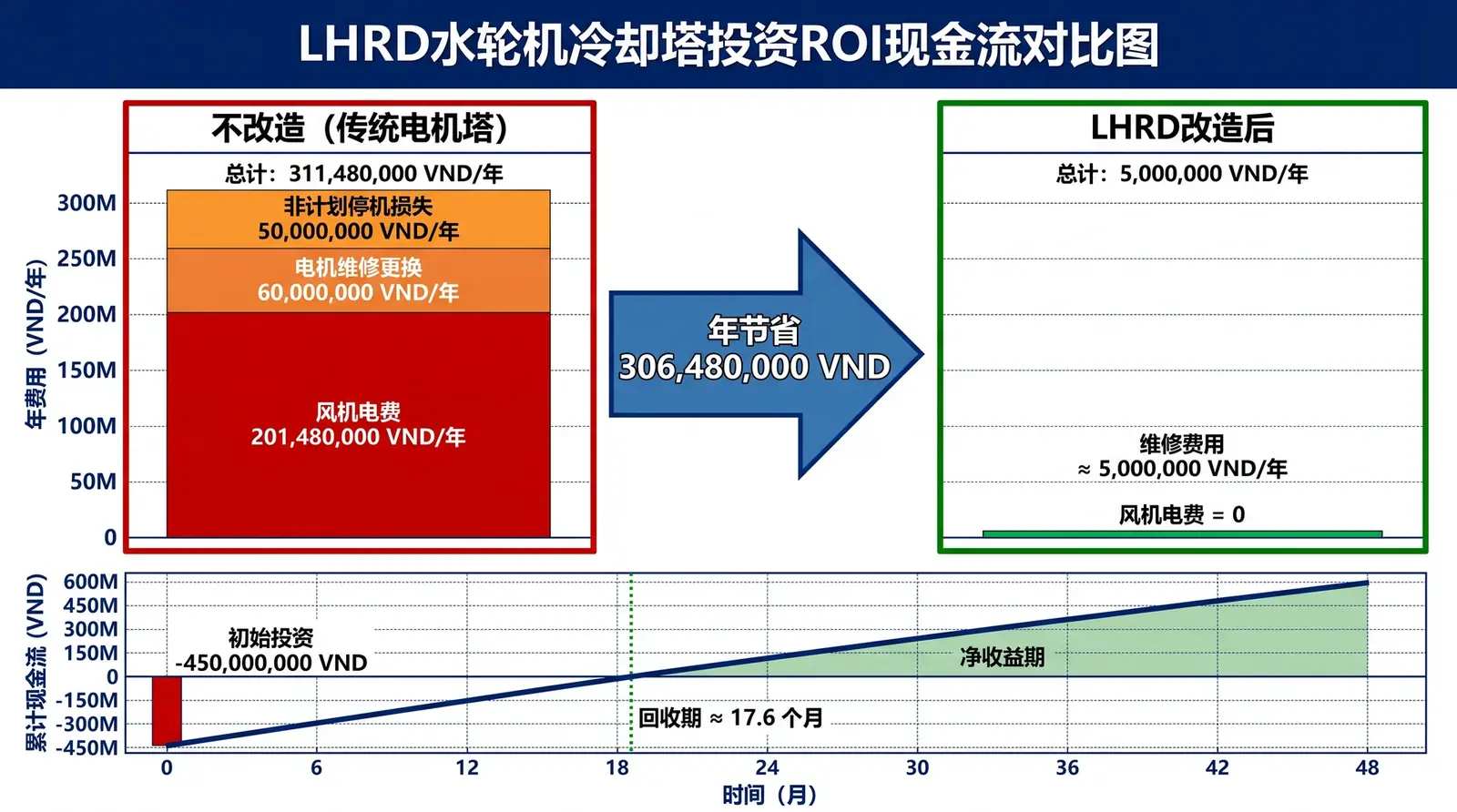
Figure 1: ROI cash-flow comparison. Annual savings include fan electricity cost, motor repair cost and unplanned downtime loss. Payback period ranges from 5.5 to 21 months depending on residual-pressure conditions.
In industrial energy-saving retrofit projects, any new technology eventually faces one question from the finance department: "How long will it take to recover this investment?" For an LHRD water-turbine-driven cooling tower, the core value is reducing the cooling tower fan drive electricity consumption to zero. But ROI cannot be calculated only from the electricity saved by the fan. Possible additional pump energy consumption, changes in maintenance cost and reductions in spare-part expenditure must all be included in the same table.
This article provides a complete payback-period calculation model, divided into two typical operating conditions: sufficient residual pressure, where pump replacement is not required, and insufficient residual pressure, where pump replacement is required. All examples are based on localized electricity tariffs, equipment costs and operating parameters in Vietnam. Readers can replace the values with the actual data from their own factories.
Physical Premise: Net Energy Saving Is Essentially an "Energy Difference"
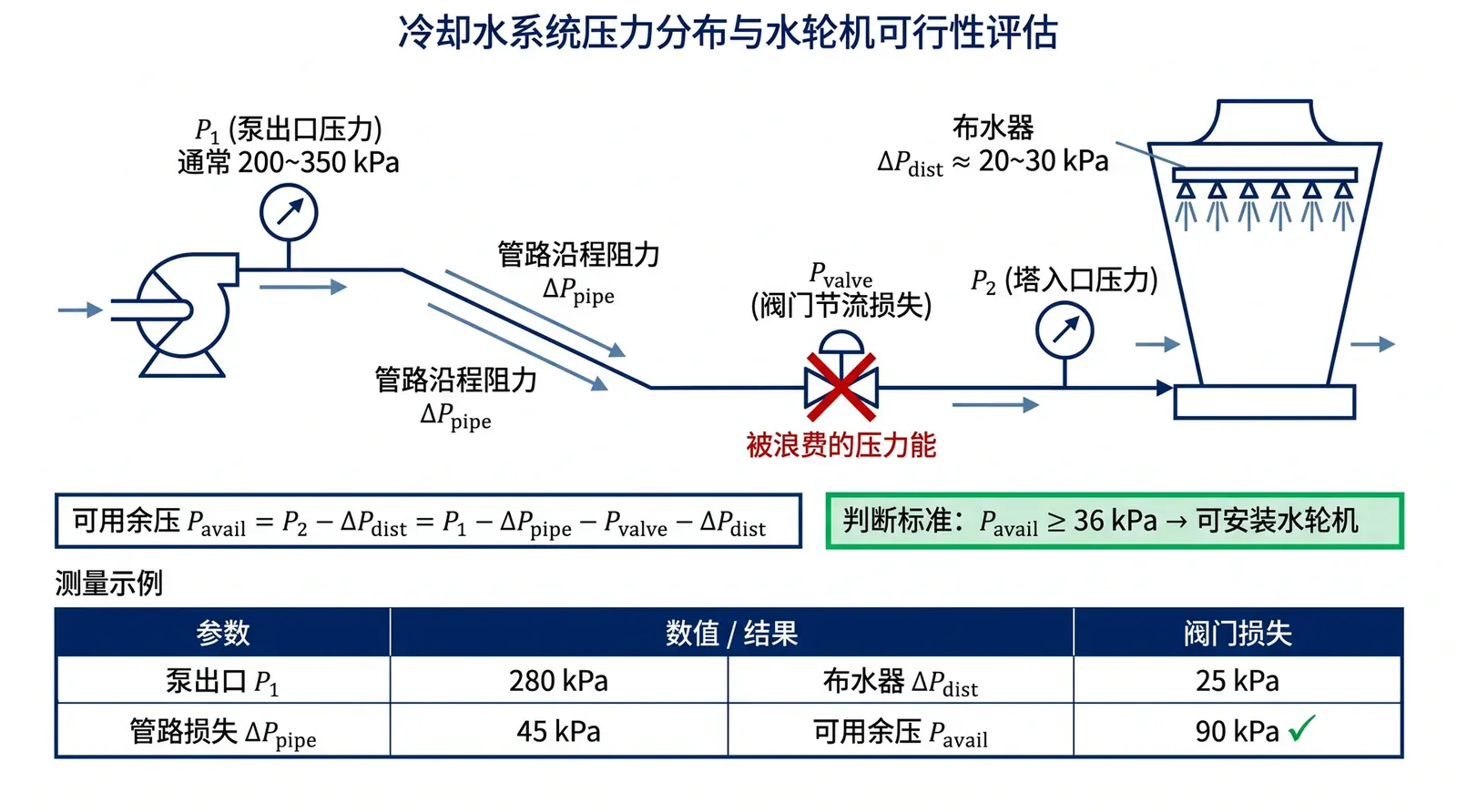
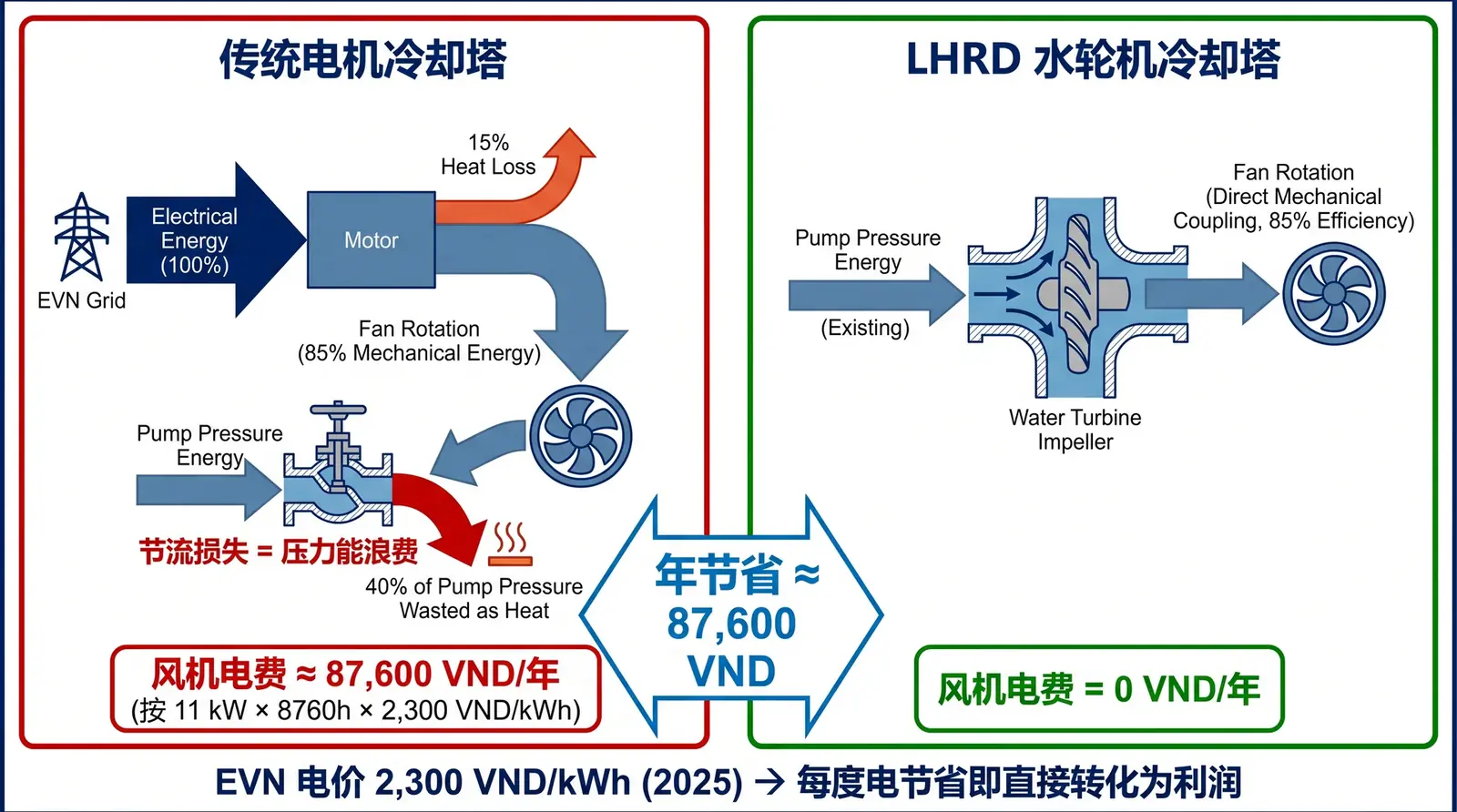
The energy-saving logic of an LHRD water-turbine-driven cooling tower can be stated briefly: the water turbine uses the available residual pressure of the circulating water system, at least 36 kPa, to drive the fan, reducing fan electricity consumption to zero. The turbine itself is a resistance element. It consumes a certain pressure drop, ΔPt, usually 36–54 kPa, to generate the torque required to drive the fan.
Therefore, the net electricity saving of an LHRD system depends on a difference: the original annual fan electricity consumption minus any additional annual pump electricity consumption, if a higher-head pump must be installed because residual pressure is insufficient. Site residual-pressure conditions determine which calculation method should be used.
Example Background
The following example is based on parameters from a real retrofit project at a chemical plant in Vietnam. The cooling system consists of three conventional motor-driven cooling towers, each 800 m³/h and each equipped with a 22 kW fan motor, giving a total fan power of 66 kW. The factory operates continuously 24/7 for 8,000 hours per year. The average EVN tariff uses the May 2025 announced value of 2,204 VND/kWh.
The LHRD retrofit keeps the original tower body, fill and water-distribution system, removes the top motor and reducer, installs the water-turbine assembly, and adds a turbine bypass on the inlet piping. The retrofit quotation per tower, including turbine hardware, site construction and commissioning support, is about VND 150 million; the total for three towers is about VND 450 million.
Scenario 1: Sufficient Residual Pressure (Operating Condition A)
Field data: the original pump outlet valve normally operates at about 60% opening, and measured available residual pressure is 45 kPa, higher than the 40 kPa required by the turbine design. The pump does not need to be replaced, and the original pump motor remains unchanged.
Annual electricity saving: total fan power is 66 kW. With an average load rate of 85%, actual operating electric power is 66 × 0.85 = 56.1 kW. Annual electricity consumption is 56.1 × 8,000 = 448,800 kWh. Annual electricity-cost saving is 448,800 × 2,204 ≈ VND 989 million.
Payback period: total investment is VND 450 million. Payback period = 450 million / 989 million ≈ 0.46 years, or about 5.5 months.
This payback period is based on the premise that the original system valve has long been throttled at about 60% opening, surplus pressure is sufficient, and the water turbine can directly replace the function of the valve without changing the pump configuration. Actual residual-pressure conditions vary widely between factories and must be confirmed by field measurement.
Scenario 2: Insufficient Residual Pressure; Pump Replacement Required (Operating Condition B)
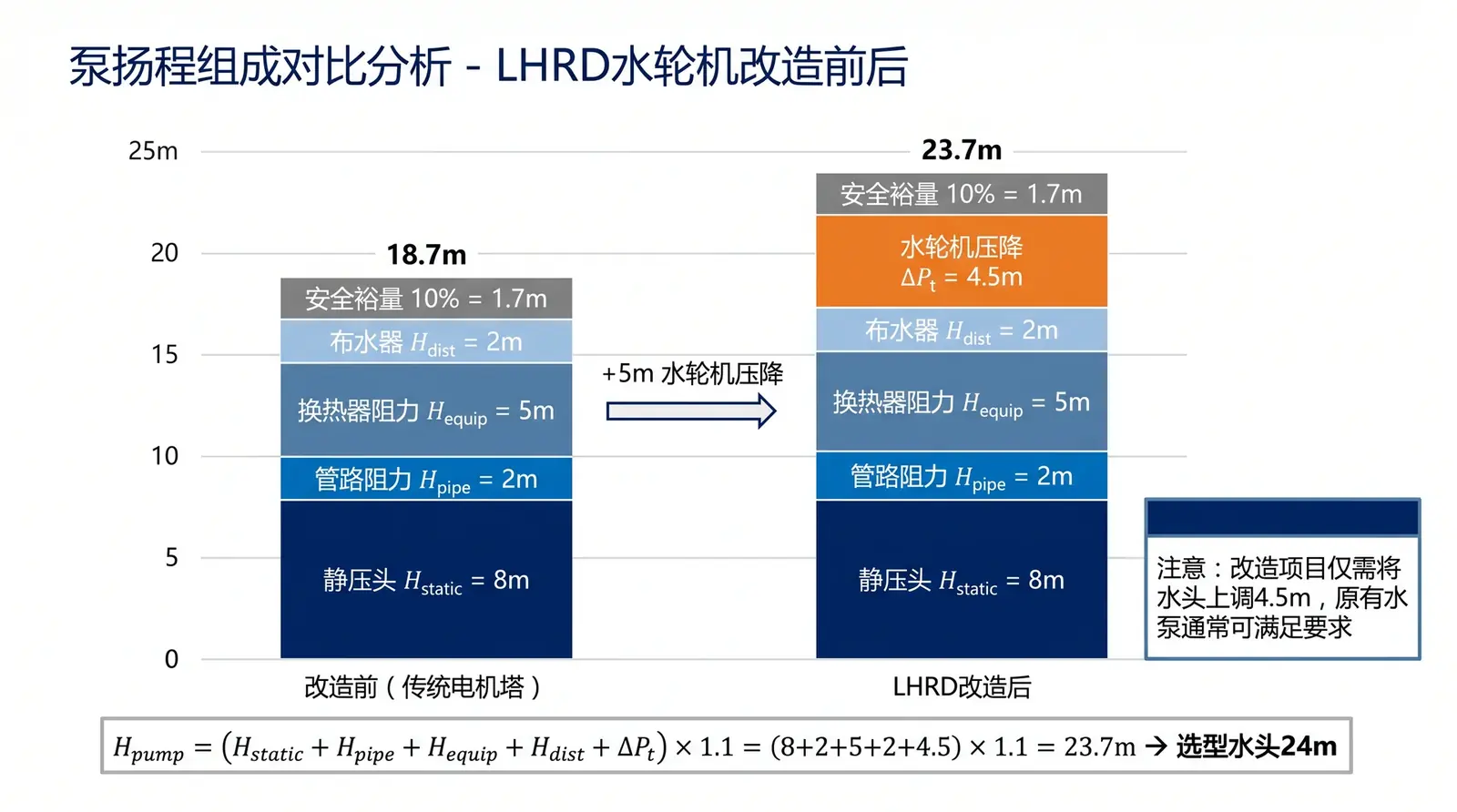
Field data: the original pump outlet valve is fully open, with no available residual pressure. A higher-head pump must be installed to meet the turbine's working pressure-drop requirement.
In this case, total investment increases to VND 450 million for the turbine retrofit plus about VND 150 million for pump replacement, including new pump purchase, installation and piping modification, for a total of VND 600 million.
Fan-side saving is the same as in Scenario 1: VND 989 million per year.
Additional pump-side electricity consumption: the new pump must add 4.5 m of head. The total circulating water flow of the three towers is 2,400 m³/h. Additional pump shaft power = (2,400 × 4.5 × 9.8) / (3,600 × 0.8) ≈ 36.75 kW. Annual additional pump electricity cost = 36.75 × 8,000 × 2,204 ≈ VND 648 million.
Net saving: VND 989 million − VND 648 million = VND 341 million per year.
Payback period: VND 600 million / VND 341 million ≈ 1.76 years, or about 21 months.
Hidden Benefits: Lower Maintenance Cost
Beyond direct electricity savings, LHRD also reduces two categories of maintenance expenditure that are often ignored in ROI calculations but are real items in a factory's annual budget.
Motor and reducer maintenance: a conventional cooling tower requires annual reducer oil replacement, belt or gear-mesh inspection, and motor insulation-resistance measurement. Every three to five years, the motor may need overhaul or replacement. For a single 22 kW motor, one replacement, including labor and lifting, costs about VND 30–50 million. After replacement with a water turbine, these periodic replacement and overhaul items are all removed.
Unplanned downtime loss: in the project mentioned at the beginning of this article, there were three unplanned shutdowns caused by water ingress into motors during the 18 months before retrofit, and zero during the 12 months after retrofit. The avoided downtime loss itself may be more significant than the electricity saving.
Including lower maintenance cost and reduced unplanned shutdowns, the comprehensive annual benefit in Scenario 1 is VND 989 million in electricity saving + VND 30 million in maintenance saving + VND 1 billion in avoided downtime = VND 2.019 billion per year. Comprehensive payback period = VND 450 million / VND 2.019 billion ≈ 0.22 years, or about 2.7 months.
Extended Questions
How should ROI be calculated for a new project? For a new project, the comparison is between "conventional tower + standard pump" and "LHRD tower + higher-head pump." If the project is in an explosion-proof area, the cost of Ex d motors, explosion-proof junction boxes and explosion-proof electrical construction is eliminated. Combined with current EVN tariffs, the incremental-investment payback period for new projects is usually 6–10 months.
If the factory is in an explosion-proof Zone 1/2 area, how much does ROI change? In an explosion-proof area, the conventional solution must use Ex d explosion-proof motors, explosion-proof junction boxes and explosion-proof distribution cabinets. Because LHRD has no electrical components on the tower top, it is naturally outside the constraints of explosion-proof electrical equipment requirements, and these additional costs are avoided. ROI in explosion-proof areas is usually 30–50% shorter than in ordinary industrial environments. For more details, see the article on Zone 1/2 explosion-proof cooling tower selection.
Reference standards: EVN Electricity Tariff Schedule 2025; ISO 50001: Energy Management Systems; ASHRAE 90.1: Energy Standard for Buildings Except Low-Rise Residential Buildings.