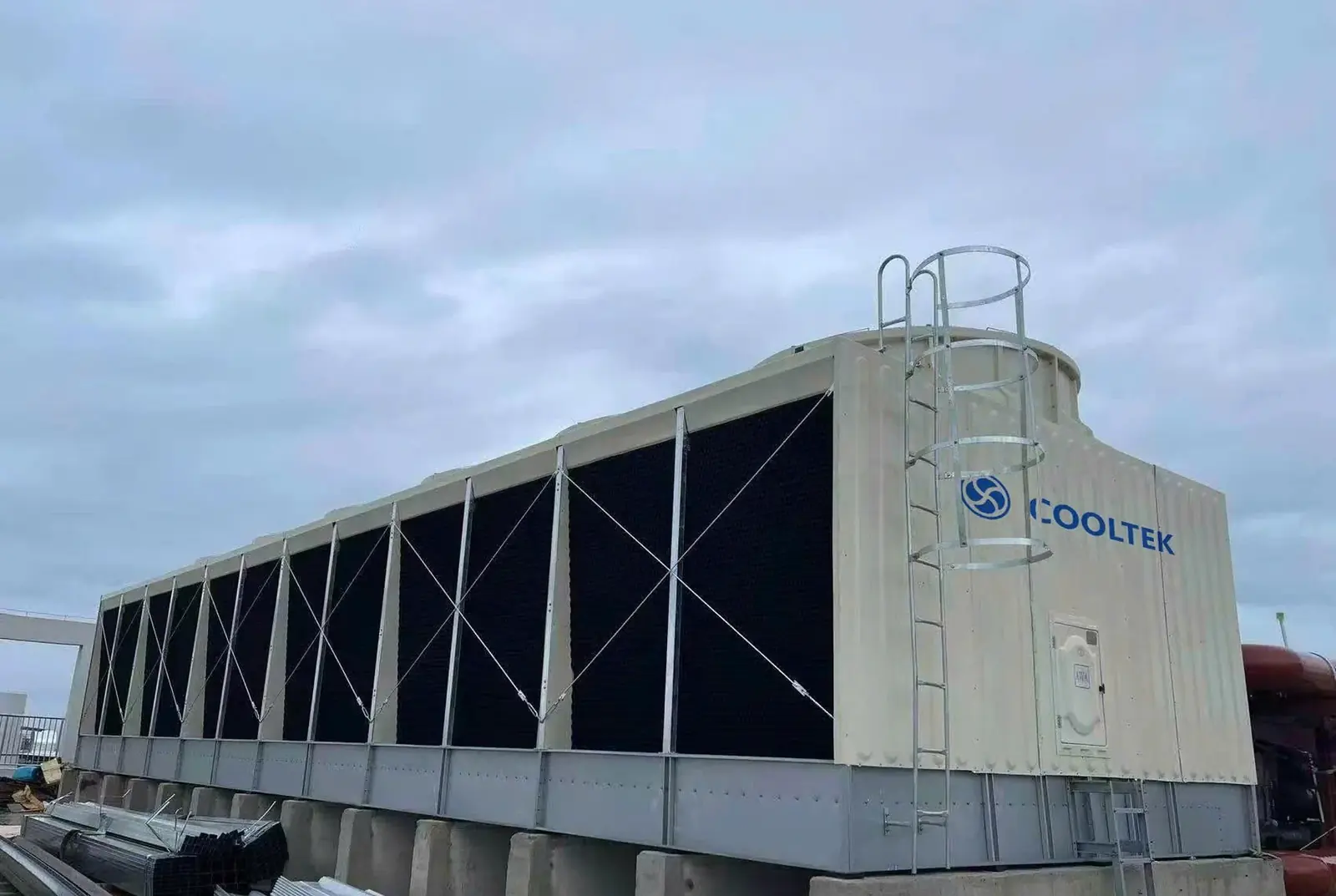
Figure 1: Lifecycle cost structure of a cooling tower — purchase price usually accounts for only 15–25% of TCO, while operating cost is the decisive factor.
In cooling tower procurement for industrial parks in Vietnam, one decision pattern appears repeatedly: the purchasing department receives quotations from three suppliers and chooses the lowest price. After the equipment has operated for two to three years, O&M cost begins to exceed expectations. After five years, the initial purchase-cost saving has already been consumed by excess electricity bills, repair costs and downtime losses.
The root cause is that the purchase price of a cooling tower is only a small part of its total lifecycle cost (TCO). This article breaks down the real total cost of a cooling tower from five dimensions, helping equipment engineers build a more complete selection-decision framework.
Dimension 1: Noise-Compliance Cost
Vietnam's QCVN 26:2025 standard takes formal effect in November 2025. It specifies a night-time boundary noise limit of 70 dBA for industrial zones and 45 dBA for factories near residential areas. The maximum penalty for violation is VND 160 million, and corrective action must be completed within the required period.
If noise compliance is not considered during selection, the later remedial cost can be very high. Adding acoustic barriers usually costs VND 0.5–2 million and has limited effect; replacing the tower with a low-noise type such as an LHR crossflow tower requires new construction work. By comparison, selecting a low-noise tower with a source noise level of 53–56 dBA during the selection stage usually increases the initial cost by only 10–20%.
Dimension 2: Operating-Cost Amplification Caused by Rising Electricity Tariffs
EVN's industrial electricity tariff in Vietnam has increased from about 1,700 VND/kWh in 2020 to about 2,204 VND/kWh in 2025, with an average annual increase of about 5%. The cooling tower fan is one of the main electricity-consuming devices in an industrial cooling system. Taking a 30 kW fan operating 8,000 hours per year as an example:
- Annual electricity cost in 2020: 30 × 8,000 × 1,700 = VND 408 million
- Annual electricity cost in 2025: 30 × 8,000 × 2,204 = VND 529 million
- Five-year increment: about VND 605 million, for the fan alone
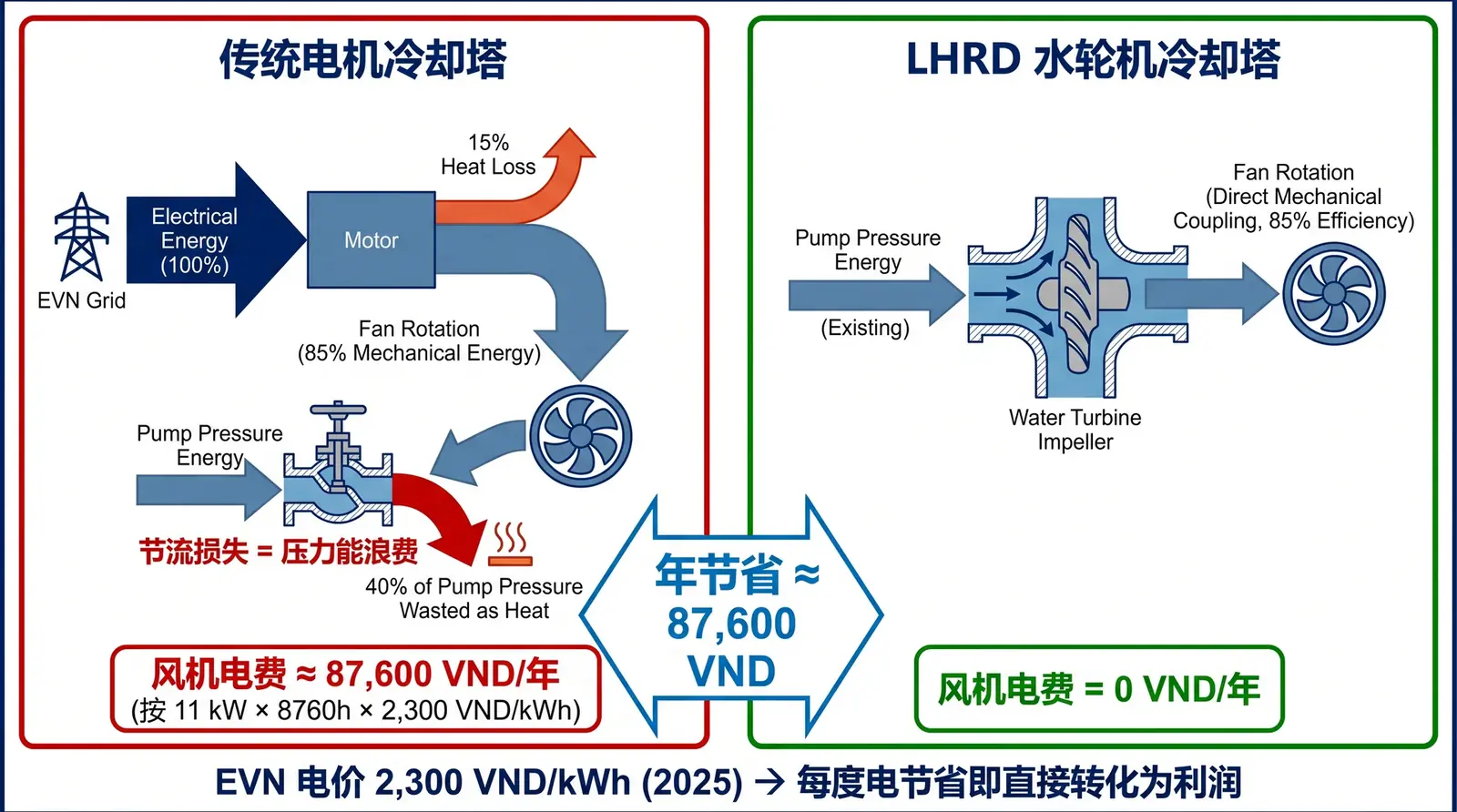
This means that spending an additional VND 0.5 million during selection for a high-efficiency motor or an LHRD water-turbine drive solution may save hundreds of millions of Vietnamese dong in electricity cost within five years.
Dimension 3: Water-Quality Protection and Equipment-Damage Risk
In an open cooling tower, circulating water is in direct contact with the atmosphere and continuously absorbs dust, SO₂, NH₃ and microorganisms from the air. For precision equipment such as medium-frequency induction furnace coils or injection-mold cooling channels, the water quality of an open tower may lead to:
- Scale blockage in precision cooling passages, such as 8–15 mm coil inner diameters, causing equipment overheating and burnout
- Corrosive gases dissolving into the circulating water and accelerating copper-tube corrosion
- Legionella exceeding limits and creating GMP compliance issues
A single burnout of a medium-frequency furnace coil, including production-loss impact, usually costs between VND 5 million and VND 20 million, far exceeding the incremental cost of an AWA closed-circuit cooling tower.
Dimension 4: Maintenance Method and Downtime Losses
Different tower types have very different effects on production continuity because of their maintenance methods.
| Tower feature | Maintenance method | Downtime risk |
|---|---|---|
| Counterflow tower with top access | Shutdown required; work at height | 4–8 hours of shutdown per maintenance event |
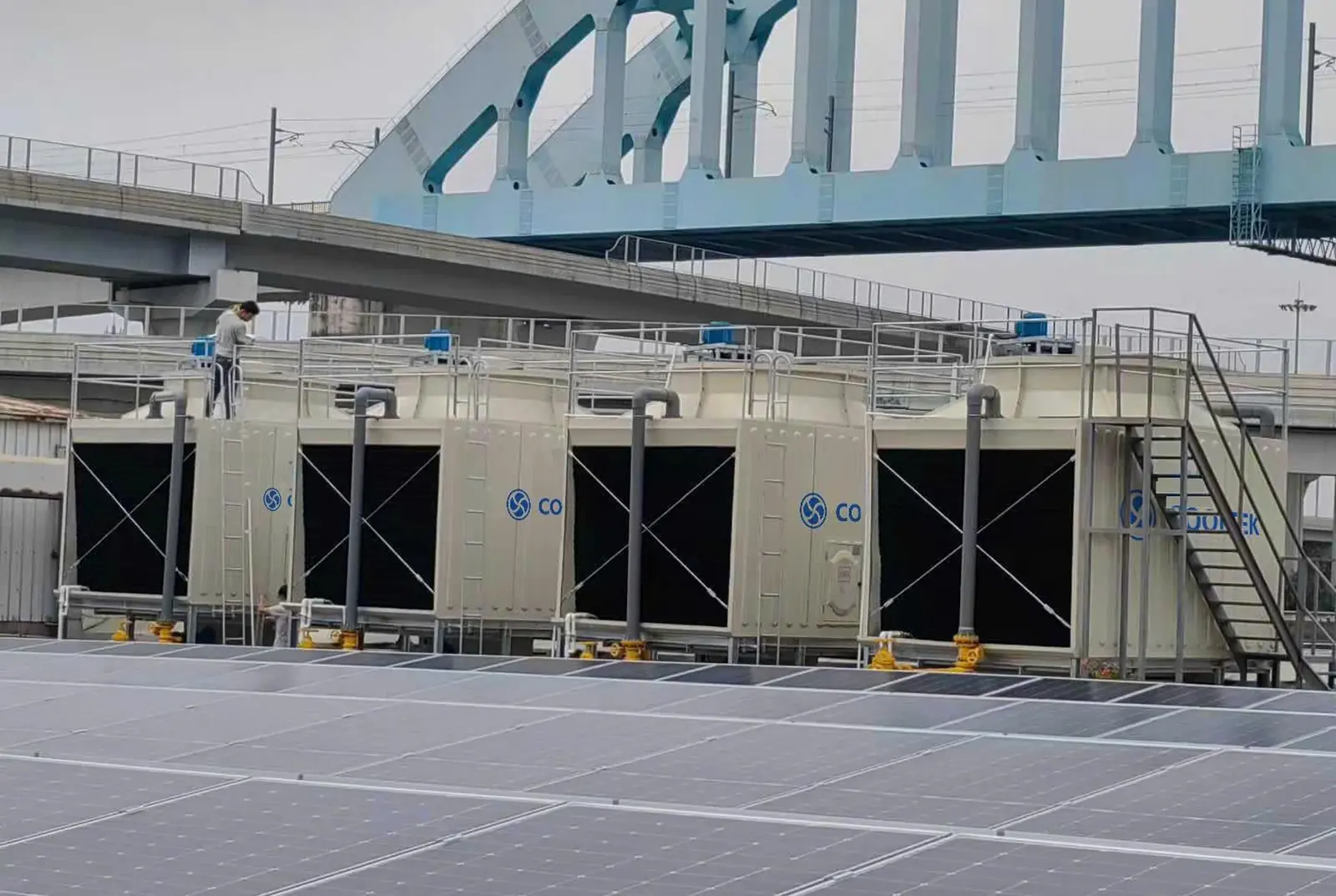
| LHR crossflow tower with side maintenance access | Can be maintained without shutdown; ground-level operation | Operation can continue during maintenance |
| LHRD water-turbine tower without motor | Semi-annual lubrication inspection; 0.5 person-day | Almost no planned downtime |
For 24/7 continuous-production factories such as food, pharmaceutical and electronics plants, the loss from each unplanned shutdown may reach millions of Vietnamese dong per hour. Spending 10–15% more during selection for a tower that can be maintained without shutdown is often recovered after one or two shutdown incidents.
Dimension 5: Long-Term Total Cost Comparison
Under the same cooling capacity, in a 15-year TCO calculation for coastal industrial zones in Vietnam, the LHR crossflow tower is usually 10–20% lower than a standard counterflow tower, mainly because of maintenance-cost savings. In systems with residual pressure, the LHRD water-turbine tower can eliminate all fan electricity cost, and the TCO difference can reach 30–50%. In precision-equipment cooling, the AWA closed-circuit tower can avoid equipment-damage losses, making its TCO advantage more significant.
It is recommended to use "five-year total cost of ownership" instead of "purchase price" as the evaluation metric, and to convert downtime losses into hourly production-value losses in the comparison table. In most cases, once management sees the quantified downtime-loss number, acceptance of a premium for low-noise towers or towers that can be maintained without shutdown increases significantly.
Reference standards: QCVN 26:2025/BTNMT National Technical Regulation on Noise; EVN Electricity Tariff Schedule 2025; ISO 50001: Energy Management Systems; ASHRAE Handbook — HVAC Systems and Equipment, Chapter 40.