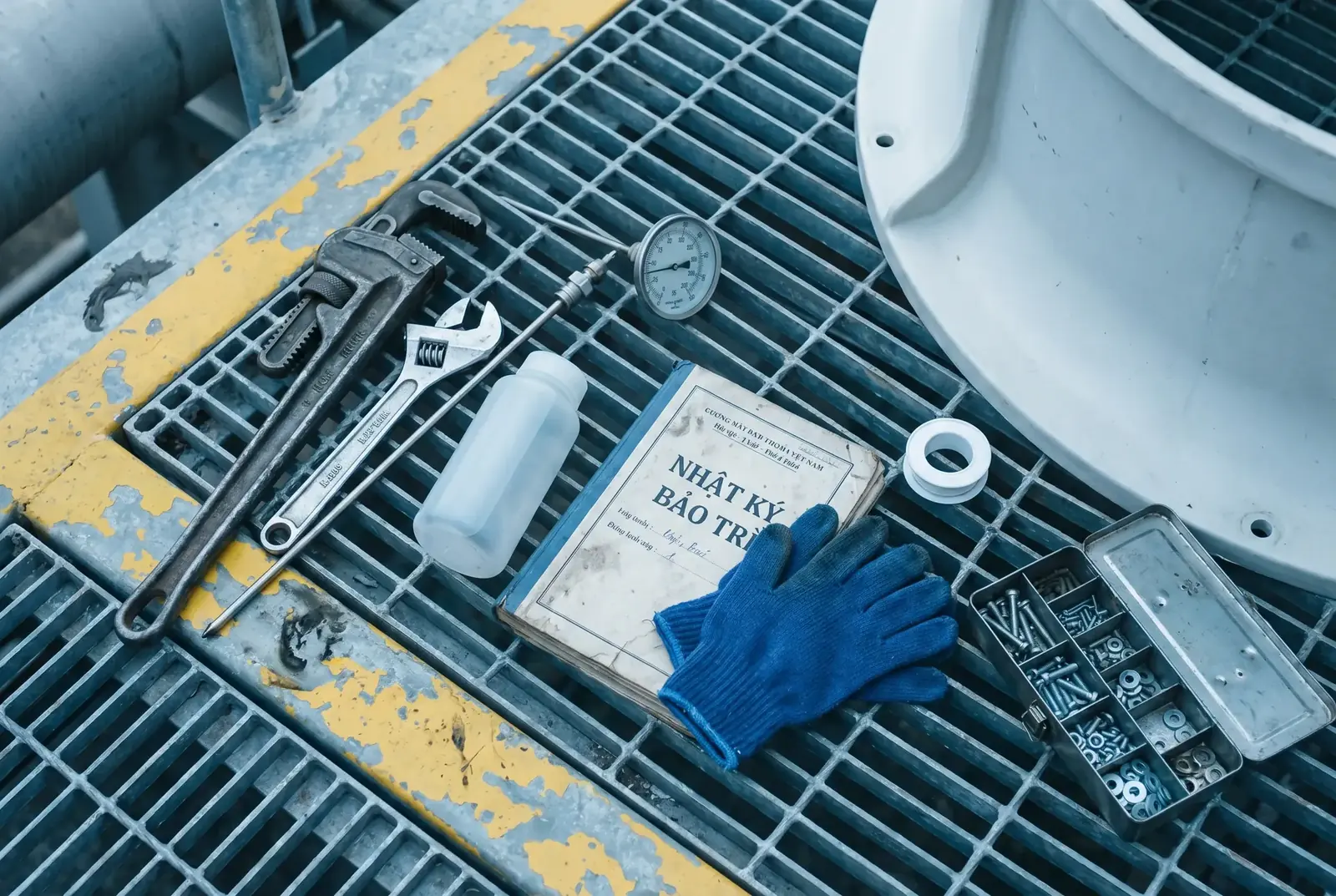
For factories that need to replace aging cooling towers, the biggest concern is usually not the cost of the new equipment itself, but the downtime and civil engineering work required during replacement. Modifying piping, reconstructing foundations, and extended shutdowns can all bring significant production losses and additional costs.
The COOLTEK LH series is specifically designed to address this pain point. Starting from the physical dimensions of standard old round towers, this article explains the five-step in-place replacement method and the specific conditions under which it applies.
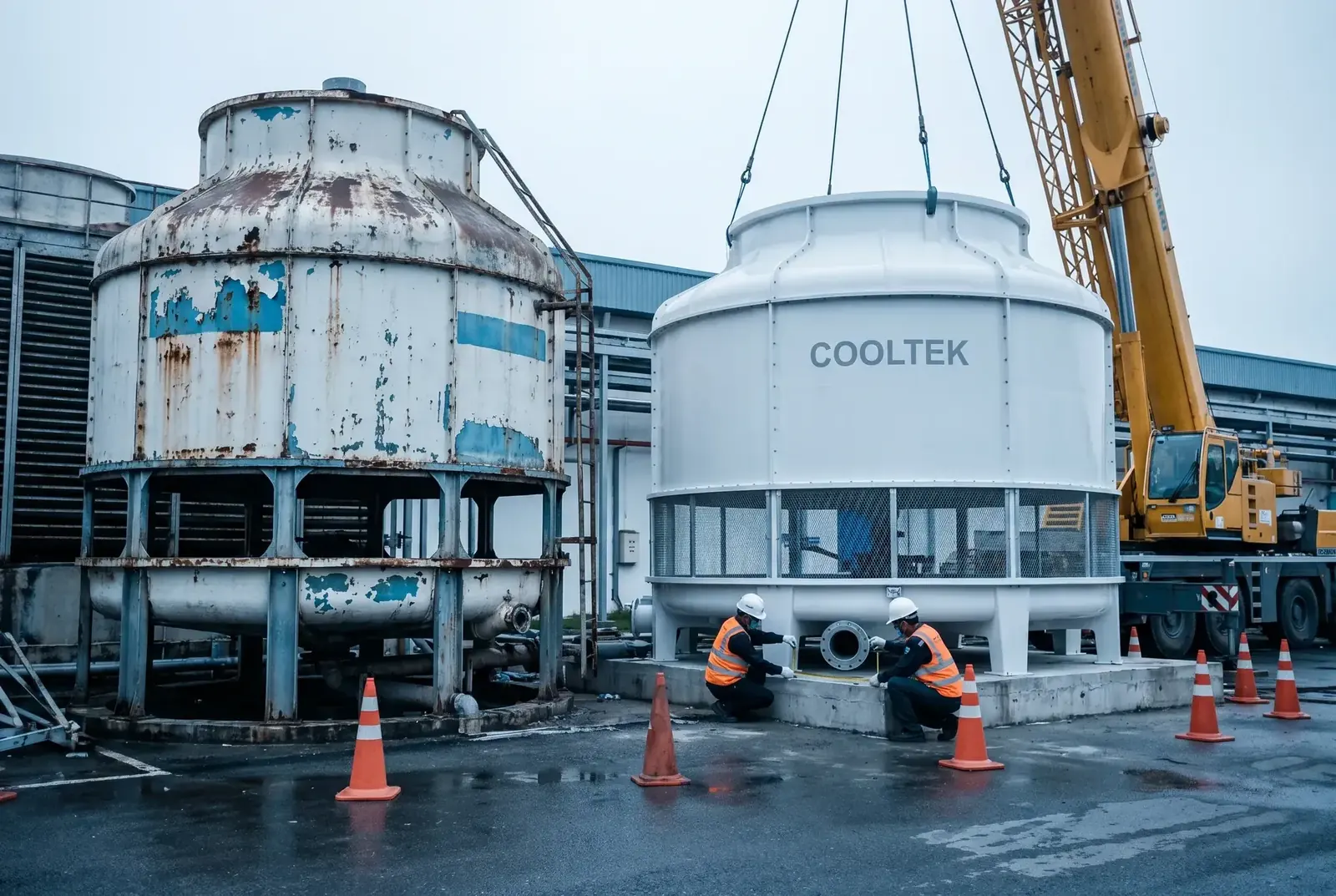
The COOLTEK LH series is designed to be physically compatible with standard old round towers, enabling direct in-place replacement without modifying piping or foundations.
1. Why Can the LH Series Be Replaced In Place?
1.1 Physical Compatibility Design
The core design principle of the COOLTEK LH series is physical compatibility with standard old round towers. Specifically:
- Anchor bolt pitch circle diameter (P.C.D.): The LH series P.C.D. is designed to match the standard dimensions of old round towers, so existing foundation anchor bolts can be reused directly.
- Inlet and outlet flange positions: The LH series inlet and outlet flange heights and positions are compatible with standard old round tower connections, eliminating the need to modify water supply and return piping.
- Overflow and drain port positions: These are also designed to match standard positions, so existing drainage piping can be reused.
This compatibility design means that in most cases, the new tower can be installed directly in the footprint of the old tower without any civil engineering work.
1.2 Scope of Application
The in-place replacement method is applicable when the following conditions are met:
- The old tower is a standard round cooling tower (the most common type in Vietnam's industrial zones).
- The foundation is in good condition with no structural damage.
- The existing piping uses standard flange connections.
- The required cooling capacity of the new tower is within the LH series flow range (8–1,000 m³/h).
If the old tower is a non-standard model or the foundation has significant damage, a site survey should be conducted first to assess whether in-place replacement is feasible.
2. Five-Step In-Place Replacement Method
Step 1: Pre-Replacement Survey and Confirmation
Before replacement, the following information must be confirmed on site:
| Survey Item | Content to Confirm | Purpose |
|---|---|---|
| Old tower model | Brand, model, flow rate | Confirm LH series compatibility |
| Foundation dimensions | P.C.D., anchor bolt specifications | Confirm whether existing bolts can be reused |
| Piping connections | Flange specifications, pipe diameters, heights | Confirm whether piping modifications are needed |
| Electrical connection | Power supply specifications, cable routing | Confirm electrical connection plan |
| Lifting conditions | Available space, crane access | Plan lifting equipment and route |
Step 2: Preparation Before Shutdown
To minimize downtime, the following preparations should be completed before the planned shutdown:
- New tower delivery and on-site inspection to confirm no transport damage.
- Preparation of all tools and materials: gaskets, bolts, grounding wire, sealant.
- Coordination of the construction team: crane operator, electrician, pipe fitter.
- Confirmation of the shutdown window and notification to relevant production departments.
Step 3: Removal of the Old Tower
After shutdown, the old tower is removed in the following sequence:
- Drain the basin water and disconnect the electrical connection.
- Disconnect the inlet and outlet water pipe flanges.
- Remove the anchor bolts (or loosen them if they are to be reused).
- Lift out the old tower body using a crane.
The entire removal process usually takes 2–3 hours.
Step 4: Installation of the New Tower
- Clean the foundation surface and check levelness (deviation ≤ ±2 mm).
- Lower the new LH tower body into position using a crane.
- Align the anchor bolt holes and tighten the bolts (torque according to specifications).
- Connect the inlet and outlet water pipe flanges, using new rubber gaskets.
- Connect the electrical power supply and check motor rotation direction.
- Connect the overflow and drain pipes.
Step 5: Commissioning and Handover
After installation, the following commissioning checks must be completed before returning to production:
- Fill the basin with water and check all connection points for leaks.
- Start the fan and check operating current (should be within the nameplate range).
- Check vibration value (should be ≤ 2.8 mm/s for standard industrial equipment).
- Measure outlet water temperature to confirm it meets design requirements.
- Record all commissioning data as baseline for future maintenance reference.
The entire replacement process — from shutdown to restart — typically takes 8–12 hours, allowing the factory to complete the replacement within a single shift.
3. Common Questions and Solutions
3.1 What If the Foundation Anchor Bolt Positions Don't Match?
If the old tower is a non-standard model with a P.C.D. that doesn't match the LH series, there are two solutions: use an adapter base plate (COOLTEK can provide custom fabrication), or drill new anchor bolt holes in the existing foundation (requires structural assessment). In most cases, the adapter base plate solution is faster and more economical.
3.2 What If the Pipe Diameters Don't Match?
If the existing piping diameter differs from the LH series flange specifications, reducer flanges can be used for connection. COOLTEK provides standard reducer flanges for common pipe size combinations, which can be installed directly without custom fabrication.
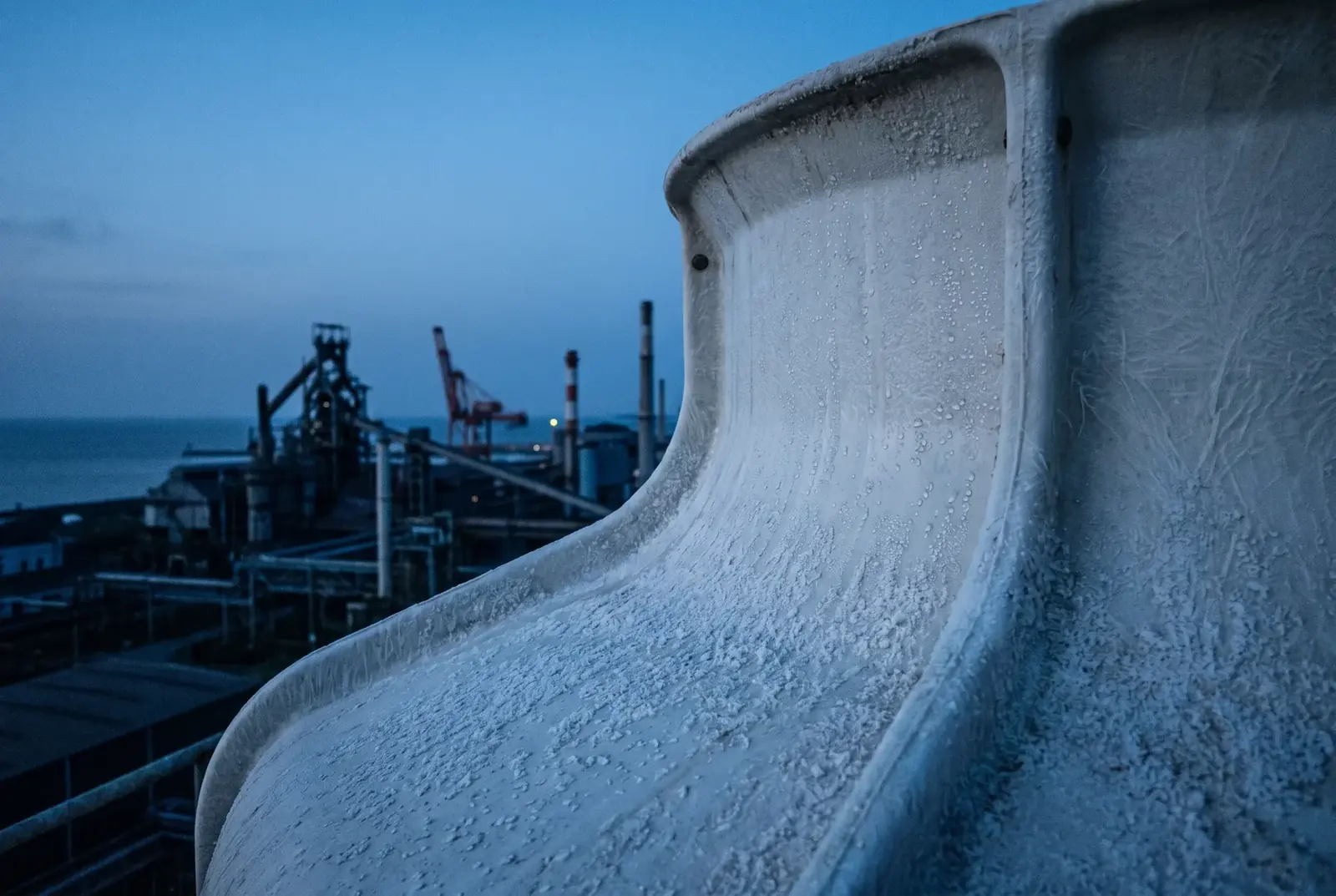
The FRP housing of the LH series passes the ASTM B117 salt spray test, with a service life of more than 15 years in coastal industrial environments.
Reference standards: GB/T 50392-2016 Code for Design of Mechanical Draft Cooling Towers; ASHRAE 2019 HVAC Systems and Equipment, Chapter 40; ASTM B117 salt spray test standard.