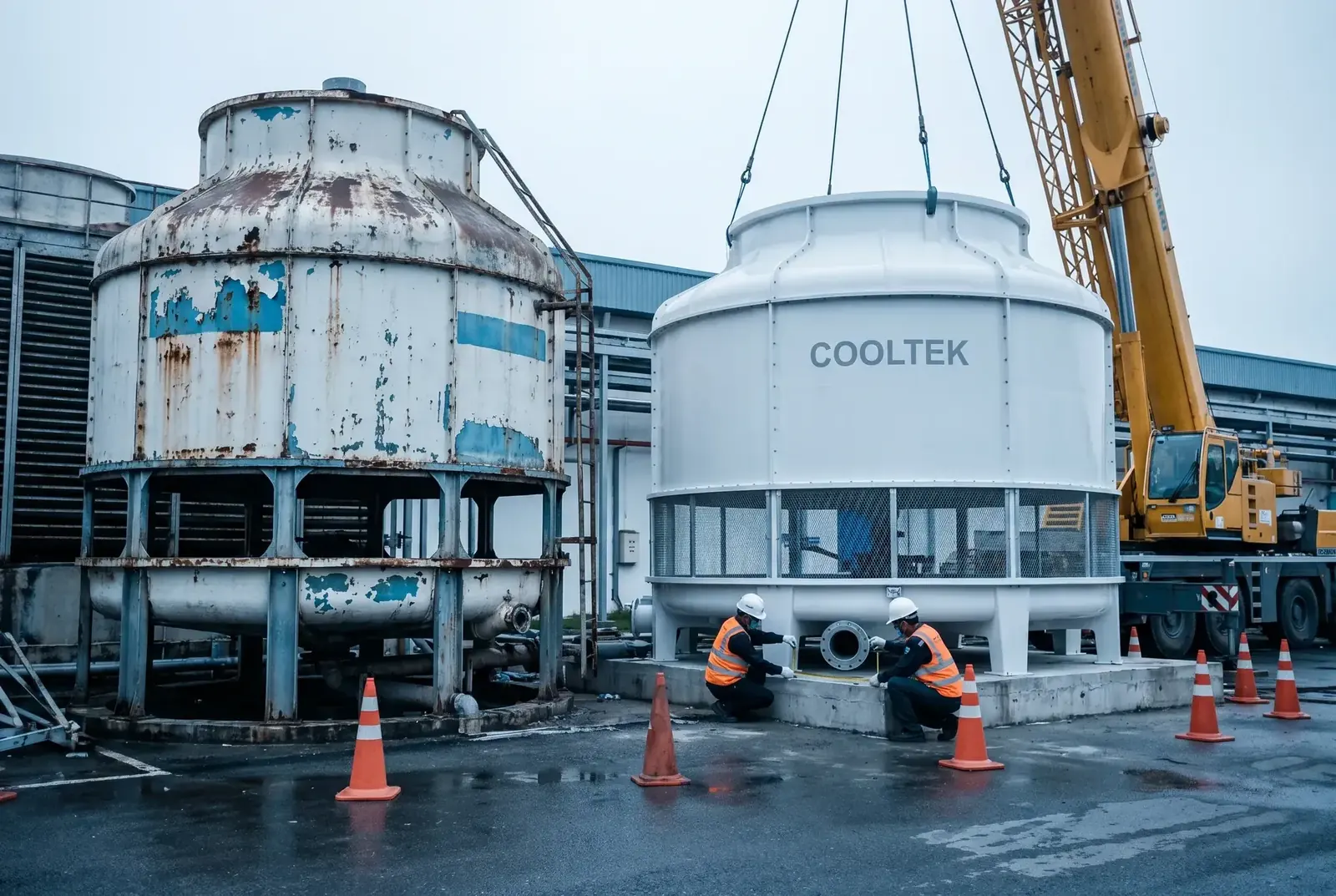
In Vietnam's coastal industrial zones — including Hai Phong, Da Nang, and Ho Chi Minh City — the combination of high humidity, high salt content, and industrial pollutants creates one of the harshest corrosion environments for cooling tower housings. The choice of housing material directly determines equipment service life and total cost of ownership (TCO).
This article uses ASTM B117 salt spray test data and actual corrosion rate measurements to quantitatively compare the service life of FRP and galvanized steel cooling towers, and provides a 15-year TCO analysis framework.
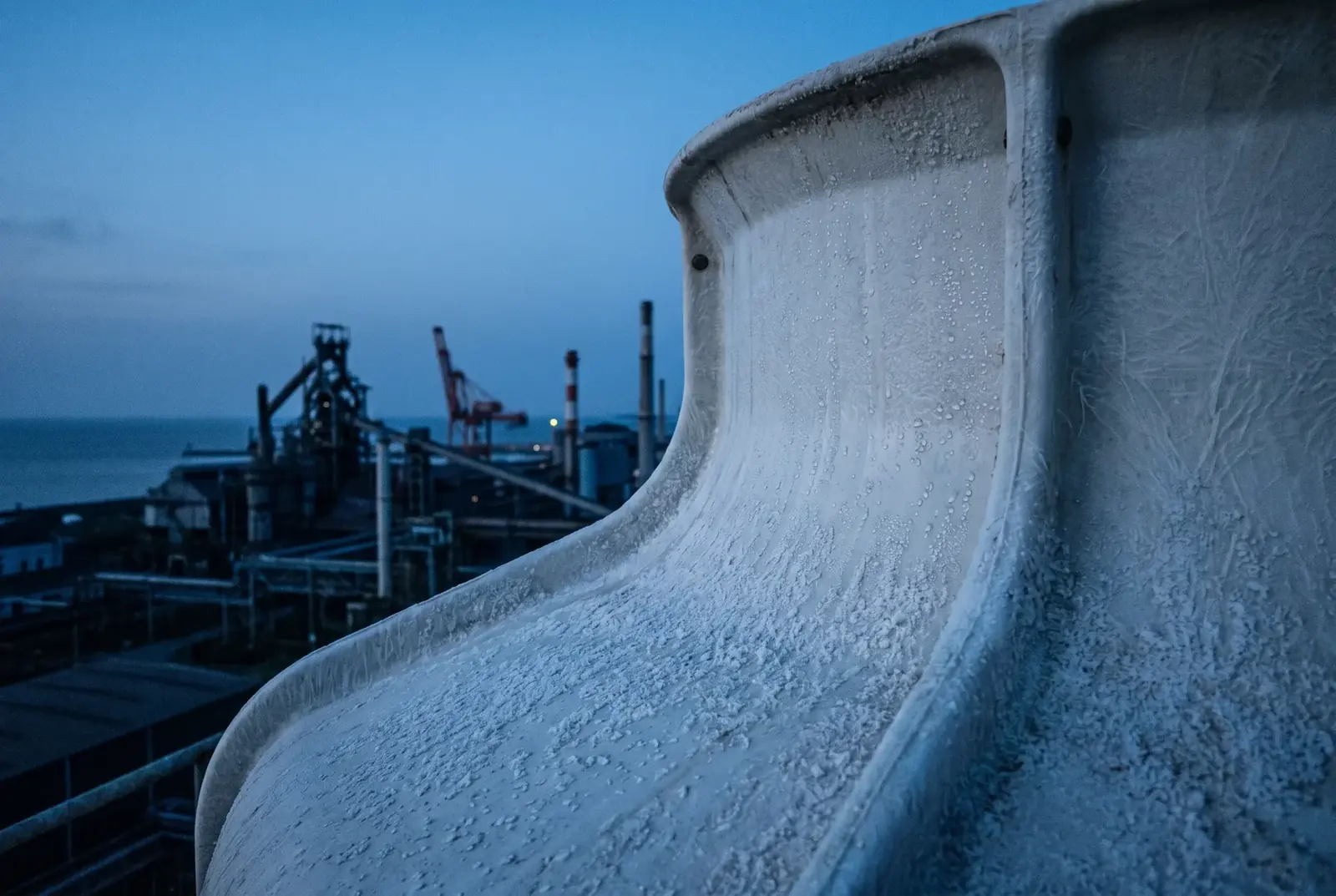
Under the ASTM B117 salt spray test, FRP housing shows no corrosion after 1,000 hours, while galvanized steel begins to show red rust after 200–400 hours.
1. Corrosion Environment Analysis in Vietnam's Coastal Industrial Zones
1.1 Main Corrosion Factors
Vietnam's coastal industrial zones face multiple corrosion factors simultaneously:
- Chloride ions (Cl⁻): Coastal air Cl⁻ concentration is typically 0.1–1.0 mg/m²/day, 10–100 times higher than inland areas. Cl⁻ penetrates the zinc layer of galvanized steel and triggers electrochemical corrosion.
- High humidity: Annual average relative humidity in coastal areas is 80–90%, providing the electrolyte environment necessary for electrochemical corrosion.
- Industrial pollutants: SO₂ and NOₓ from industrial zones react with water to form acid rain (pH 4.5–5.5), accelerating metal corrosion.
- High temperature: Vietnam's annual average temperature of 25–28°C accelerates chemical reaction rates. For every 10°C increase in temperature, the corrosion rate approximately doubles.
1.2 ASTM B117 Salt Spray Test Data
According to the ASTM B117 standard salt spray test (5% NaCl solution, 35°C), the corrosion resistance performance of different materials is as follows:
| Material | Time to First Red Rust | Equivalent Outdoor Service Life (Coastal) |
|---|---|---|
| FRP (fiberglass reinforced plastic) | >2,000 hours (no corrosion) | >20 years |
| Hot-dip galvanized steel (85 μm zinc layer) | 400–600 hours | 8–12 years |
| Standard galvanized steel (40–60 μm zinc layer) | 200–400 hours | 3–5 years |
| Painted carbon steel | 100–200 hours | 1–3 years |
Note: The conversion from salt spray test hours to outdoor service life uses a ratio of approximately 1 hour of salt spray ≈ 1 week of coastal outdoor exposure, based on ISO 9223 corrosion classification data.
2. Actual Corrosion Rate Comparison
2.1 Zinc Layer Consumption Rate
In Vietnam's coastal industrial environment, the zinc layer consumption rate of galvanized steel is approximately 8–15 μm/year. For a standard hot-dip galvanized layer of 85 μm thickness:
- Years 1–3: Surface oxidation, zinc layer intact, appearance slightly dull.
- Years 3–6: Zinc layer consumption rate accelerates, local pitting begins.
- Years 6–10: Zinc layer depleted in local areas, base steel exposed, red rust appears.
- Years 10–15: Structural integrity compromised, replacement required.
2.2 FRP Aging Characteristics
FRP (fiberglass reinforced plastic) does not undergo electrochemical corrosion. Its main aging mechanisms are UV degradation and resin hydrolysis:
- UV degradation: surface resin gradually yellows and chalks, but this is a surface phenomenon that does not affect structural strength.
- Resin hydrolysis: in long-term water immersion environments, the resin matrix may absorb water and slightly decrease in strength, but the rate is very slow.
- Typical service life: under normal operating conditions, FRP housing service life exceeds 20 years, with some installations exceeding 25 years.
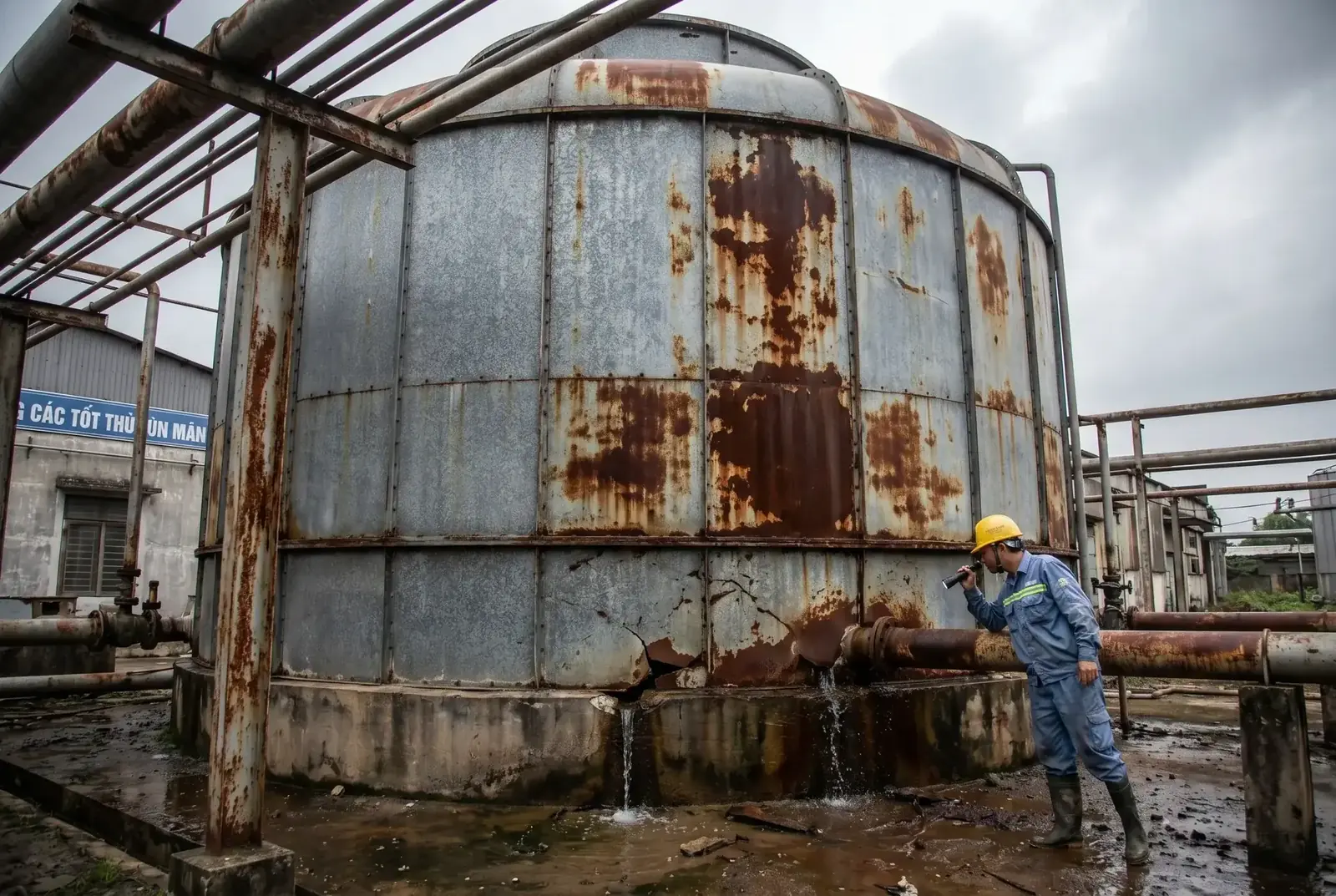
15-year TCO analysis: although FRP towers have a higher initial cost, the total cost of ownership is 40–60% lower than galvanized steel towers due to lower replacement frequency and maintenance costs.
3. 15-Year Total Cost of Ownership (TCO) Analysis
3.1 TCO Calculation Framework
Taking a 200 m³/h cooling tower as an example, the 15-year TCO comparison between FRP and galvanized steel towers is as follows:
| Cost Item | FRP Tower (LH Series) | Galvanized Steel Tower |
|---|---|---|
| Initial purchase cost | Baseline × 1.20 | Baseline × 1.00 |
| Replacement frequency (15 years) | 0 times (service life >20 years) | 1–2 times (service life 8–12 years) |
| Replacement cost (equipment + labor) | 0 | Baseline × 1.0–2.0 |
| Annual maintenance cost | Lower (no anti-corrosion treatment) | Higher (annual anti-corrosion coating) |
| 15-year TCO | Baseline × 1.20 | Baseline × 2.0–3.0 |
The above calculation shows that although FRP towers have a 20% higher initial cost, the 15-year TCO is 40–60% lower than galvanized steel towers, primarily because replacement costs are avoided.
3.2 Special Considerations for Coastal Industrial Zones
In Vietnam's coastal industrial zones (Hai Phong, Da Nang, Vung Tau), the corrosion environment is more severe than the national average. The actual service life of galvanized steel towers may be shortened to 5–8 years, making the TCO advantage of FRP towers even more pronounced.
Reference standards: ASTM B117 standard practice for operating salt spray apparatus; ISO 9223 corrosion of metals and alloys — corrosivity of atmospheres; ASHRAE 2019 HVAC Systems and Equipment, Chapter 40.