
Receiving a noise complaint or failing a regulatory noise inspection is a stressful situation. However, cooling tower noise exceedance is a solvable engineering problem. The key is to follow a systematic diagnostic process before committing to a remediation strategy.
This article provides a step-by-step guide to diagnosing cooling tower noise exceedance and selecting the most cost-effective solution under QCVN 26:2025.
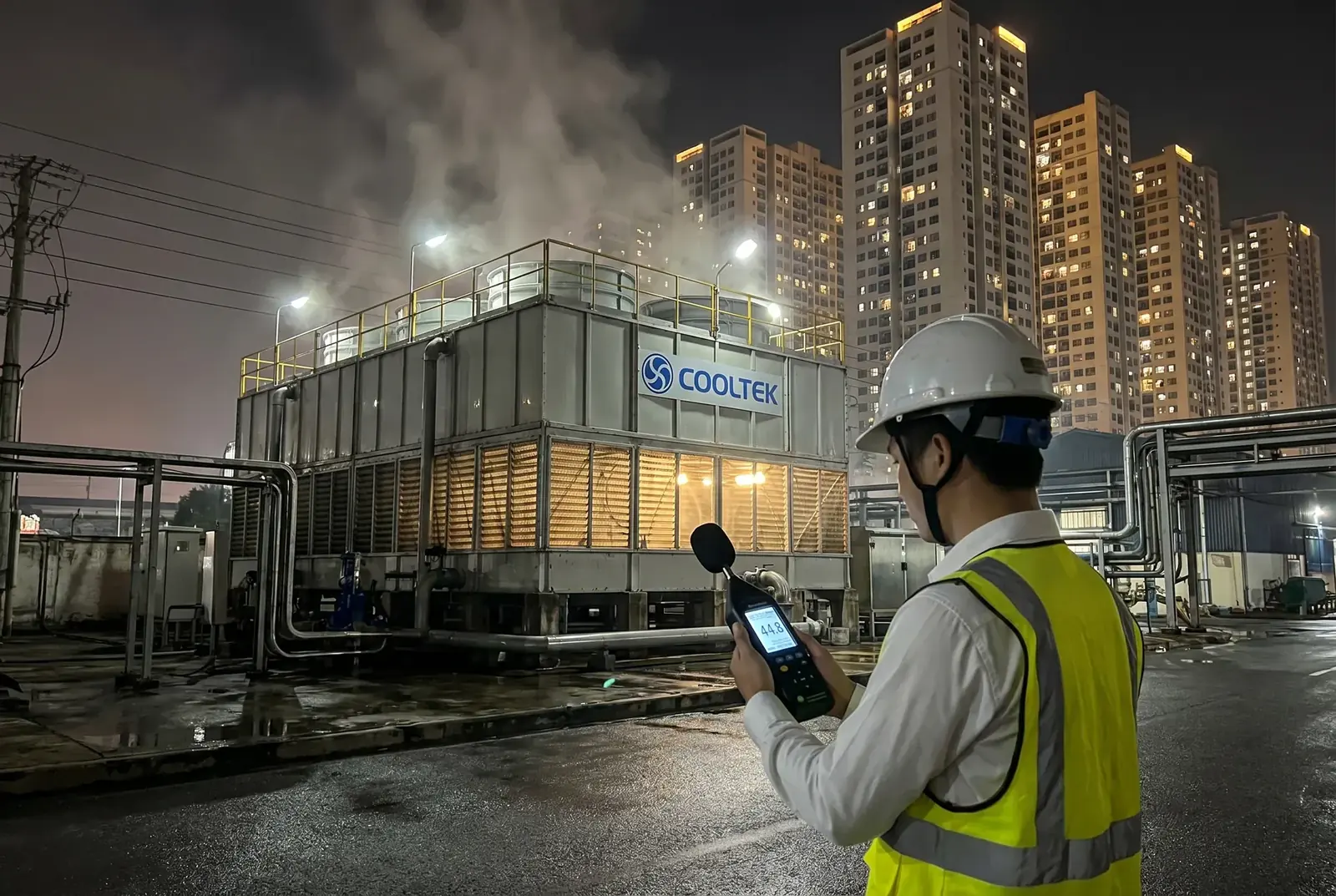
Resolving cooling tower noise exceedance requires first identifying the dominant noise source, then selecting the most cost-effective attenuation strategy for the specific installation.
1. Step 1: Diagnose the Noise Source
1.1 Identify the Dominant Noise Component
Cooling tower noise has three main components. Identifying which component is dominant determines the appropriate remediation strategy:
| Noise Component | Characteristics | Diagnostic Method |
|---|---|---|
| Fan aerodynamic noise | Broadband, increases with fan speed; blade passing frequency tone may be audible | Measure noise with fan running vs. stopped (pump only) |
| Water impact noise | Splashing sound, most prominent at basin level; increases with flow rate | Measure noise at basin level vs. top of tower |
| Motor/mechanical noise | Tonal, specific frequencies; may include gear mesh frequency if gearbox is used | Vibration analysis and frequency spectrum measurement |
1.2 Quantify the Exceedance
Before selecting a remediation strategy, quantify the exceedance:
- Measure the current noise level at the compliance point (property boundary or nearest receptor).
- Determine the applicable QCVN 26:2025 limit for the zone.
- Calculate the required attenuation: required attenuation = measured level − limit.
This calculation determines how much attenuation is needed and guides the selection of remediation options.
2. Step 2: Select the Remediation Strategy
2.1 Option A: Fan Speed Reduction
Applicable when: Fan aerodynamic noise is dominant AND the system has excess cooling capacity.
Effect: Reducing fan speed by 10% reduces noise by approximately 3 dB(A) and reduces cooling capacity by approximately 10%.
Cost: Low (variable frequency drive installation if not already present: 15–30 million VND).
Limitation: Cannot provide more than 5–6 dB(A) attenuation without significant cooling capacity loss.
2.2 Option B: Acoustic Barrier Wall
Applicable when: The noise-sensitive receptor is in a specific direction from the tower AND there is space for a barrier wall.
Effect: A properly designed barrier wall can provide 8–15 dB(A) attenuation on the shielded side.
Design requirements: The barrier must be taller than the line of sight between the tower and the receptor. The barrier must not restrict airflow to the tower (maintain ≥1.5 m clearance from tower air inlet).
Cost: Medium (concrete or masonry barrier: 50–150 million VND depending on size).
2.3 Option C: Tower Replacement with LHR Crossflow
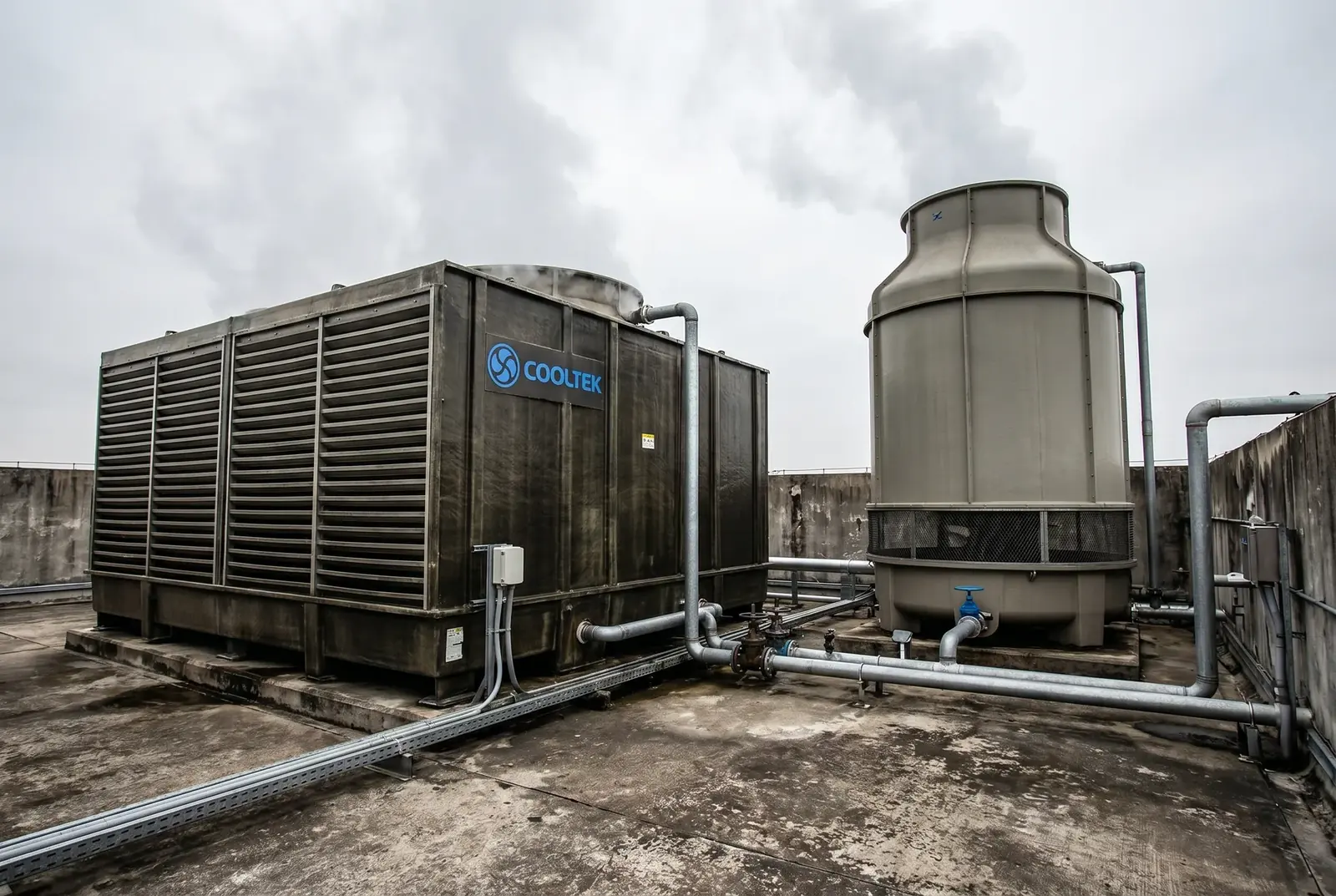
Replacing a counterflow tower with an LHR crossflow tower provides 10–16 dB(A) noise reduction — the most effective single remediation measure available.
Applicable when: The existing tower is aging (>8 years) OR the required attenuation exceeds 8 dB(A).
Effect: The LHR crossflow tower is 10–16 dB(A) quieter than equivalent-capacity counterflow towers.
Additional benefits: 30–60 kPa lower water-side pressure drop, online maintenance capability, extended service life.
Cost: Higher initial cost, but typically the most cost-effective solution over a 5–10 year horizon when energy savings and maintenance cost reduction are included.
2.4 Option D: Acoustic Enclosure
Applicable when: Required attenuation exceeds 15 dB(A) AND tower replacement is not feasible.
Effect: Full acoustic enclosure with attenuated inlet/outlet ducts can provide 15–25 dB(A) attenuation.
Design requirements: Requires careful aerodynamic design to maintain adequate airflow. Increases tower air-side resistance, reducing cooling capacity by 5–15% unless fan power is increased.
Cost: High (100–300 million VND depending on tower size and required attenuation).
3. Remediation Strategy Comparison
| Strategy | Attenuation (dB(A)) | Cost (million VND) | Additional Benefits | Best For |
|---|---|---|---|---|
| Fan speed reduction | 3–6 | 15–30 | Energy saving | Minor exceedance, excess capacity |
| Acoustic barrier | 8–15 | 50–150 | None | Directional exceedance |
| LHR replacement | 10–16 | 200–500 | Energy + maintenance savings | Aging tower, >8 dB(A) exceedance |
| Acoustic enclosure | 15–25 | 100–300 | None | >15 dB(A) exceedance, replacement not feasible |
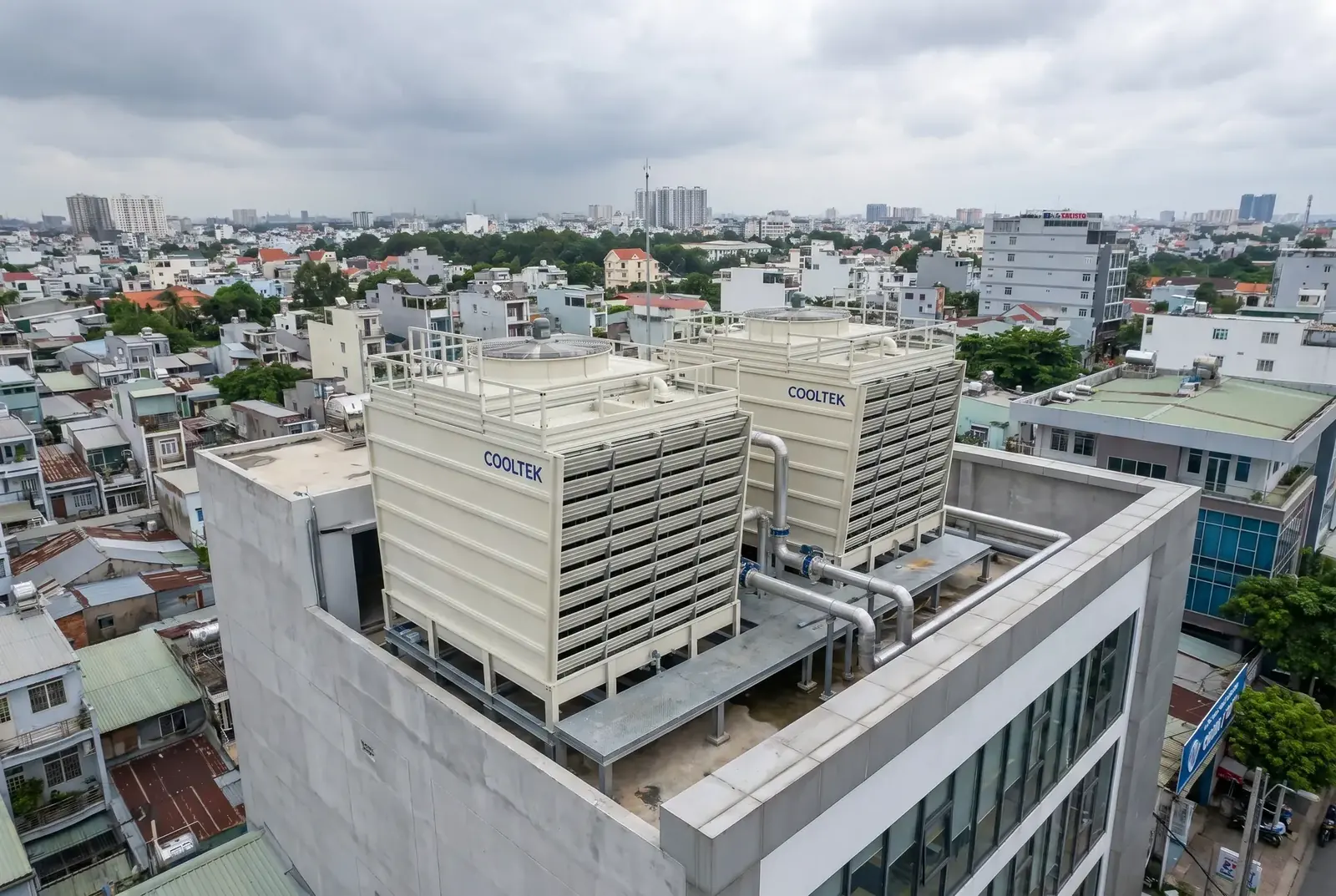
For most cases of cooling tower noise exceedance under QCVN 26:2025, tower replacement with the LHR series provides the best combination of noise reduction and long-term cost savings.
4. Documentation for Regulatory Compliance
After implementing remediation measures, the following documentation should be prepared for regulatory submission:
- Pre-remediation noise measurement report (certified laboratory)
- Description of remediation measures implemented
- Post-remediation noise measurement report confirming compliance
- Equipment specifications for any new equipment installed (noise rating, model number)
Reference standards: QCVN 26:2025 National Technical Regulation on Noise; ISO 1996-2:2017 Acoustics — Description, measurement and assessment of environmental noise; CTI ATC-128 cooling tower sound measurement standard.