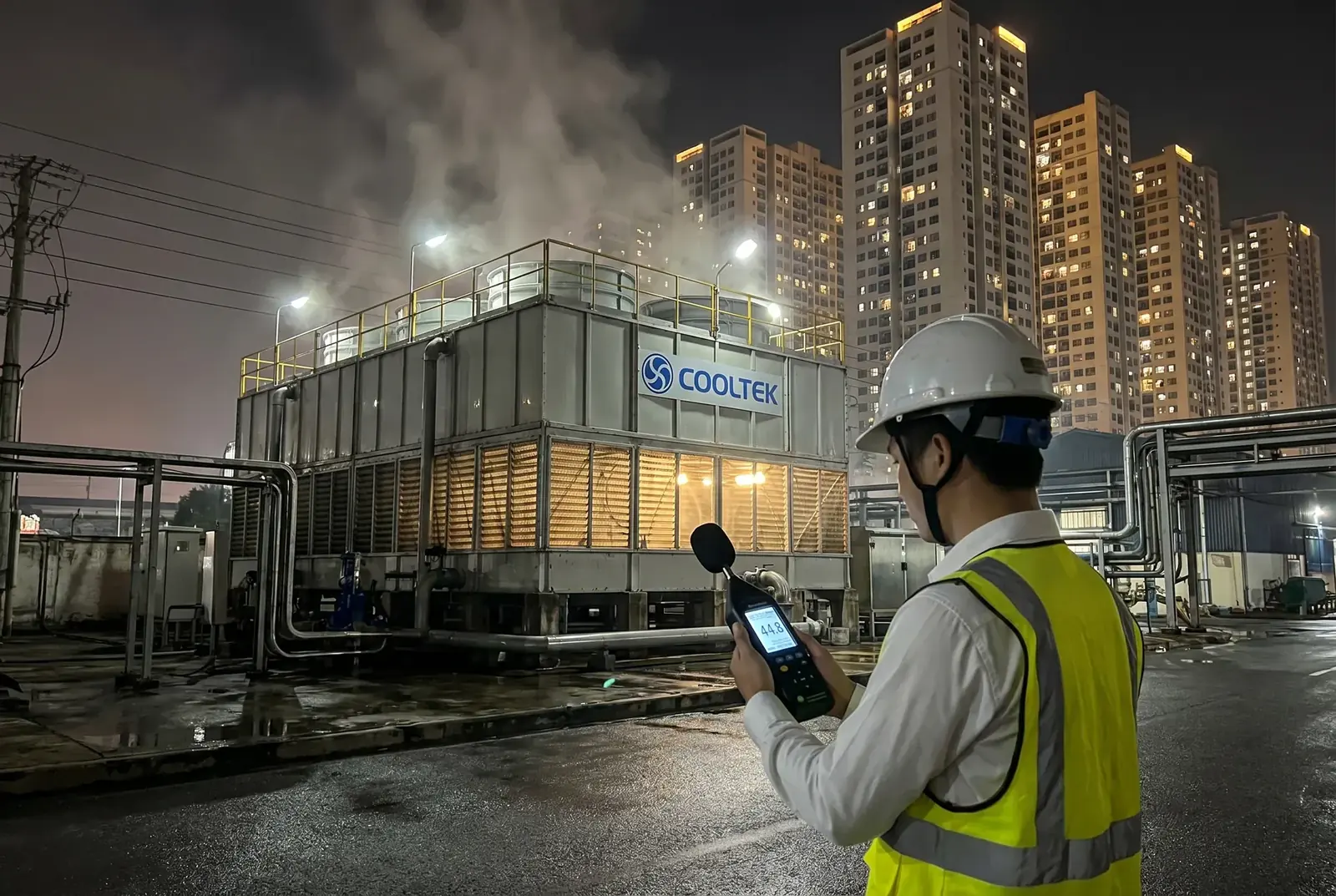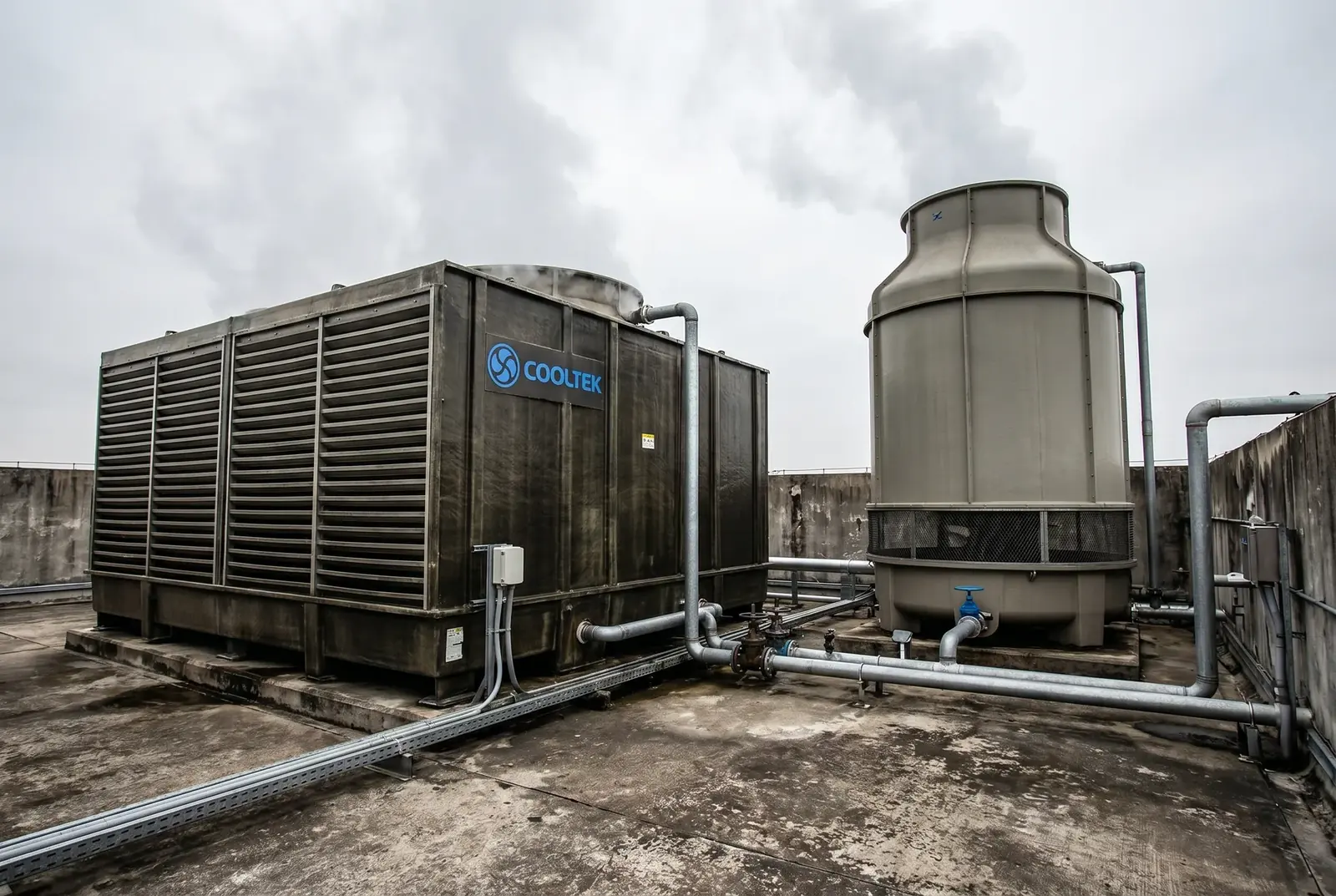
When industrial plant engineers select cooling towers, they typically start with the thermal performance specification: flow rate, approach temperature, and cooling range. Noise is a secondary consideration.
Commercial building applications — hotels, hospitals, office buildings, mixed-use developments — require a fundamentally different selection approach. In these applications, noise performance is the primary constraint, and thermal performance is secondary.
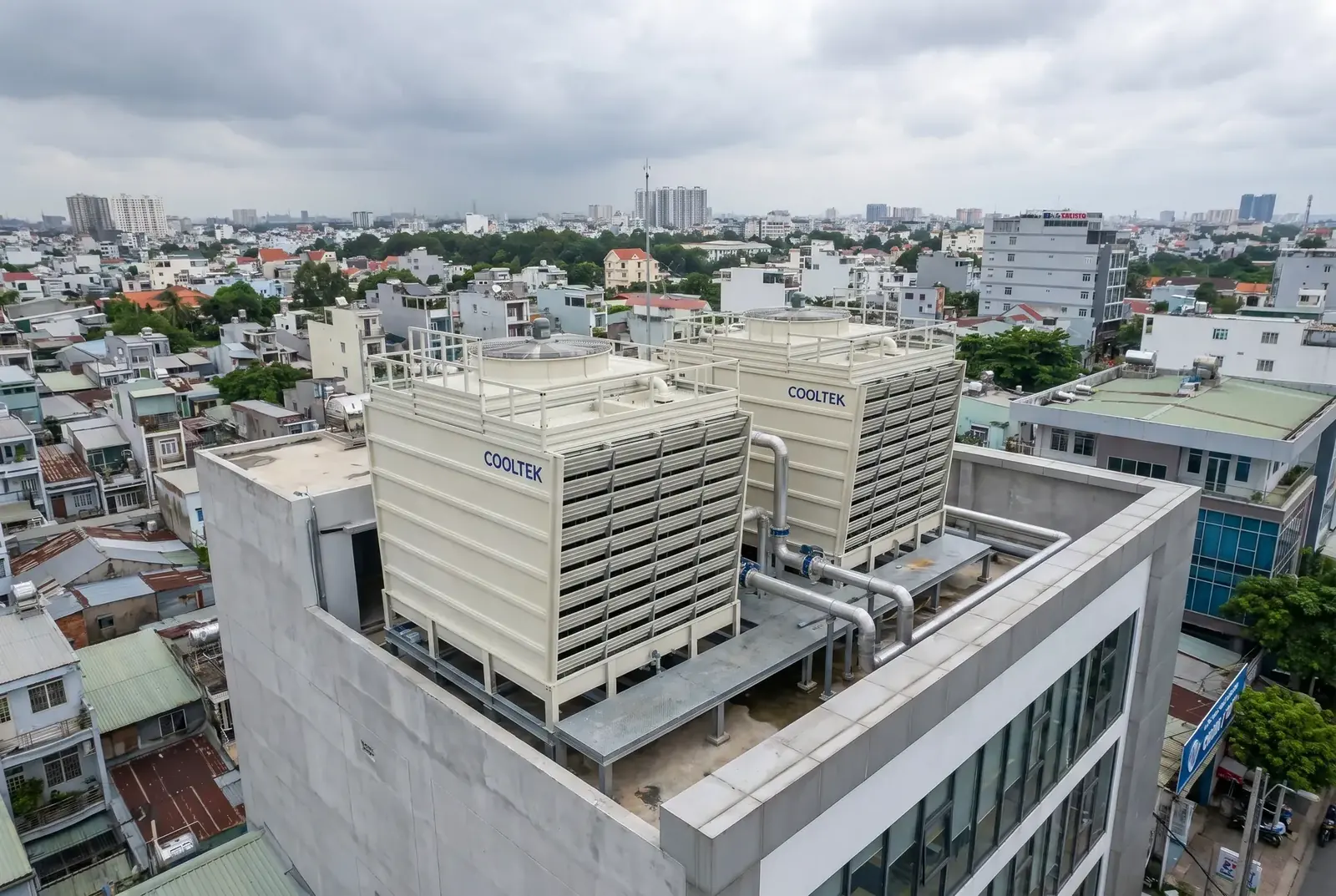
In commercial building applications, the cooling tower is typically located on the rooftop or in a plant room adjacent to occupied spaces. Noise performance determines whether the installation is acceptable to occupants and regulators.
1. Why Noise Is the Primary Constraint in Commercial Buildings
1.1 Proximity to Occupied Spaces
In industrial plants, cooling towers are typically located in dedicated equipment areas, separated from occupied workspaces by distance and barriers. In commercial buildings, the cooling tower is often located:
- On the rooftop, directly above occupied floors
- In a basement plant room adjacent to parking or service areas
- In a rooftop plant room adjacent to penthouse apartments or hotel rooms
- On a podium level adjacent to residential units in mixed-use developments
In all of these locations, the distance between the cooling tower and noise-sensitive spaces is typically 5–20 m, compared to 50–200 m in industrial settings.
1.2 Regulatory Requirements for Commercial Buildings
Commercial buildings in Vietnam are typically located in residential or mixed commercial/residential zones, subject to the strictest QCVN 26:2025 noise limits:
- Residential zones: 55 dB(A) daytime, 45 dB(A) nighttime
- Mixed commercial/residential zones: 65 dB(A) daytime, 55 dB(A) nighttime
A standard counterflow cooling tower operating at 72–78 dB(A) at 1 m would exceed the residential zone daytime limit at distances up to 30–50 m. In a rooftop installation above a hotel, this is clearly unacceptable.
2. Noise-First Selection Framework for Commercial Buildings
2.1 Step 1: Establish the Noise Budget
Before specifying the cooling tower, establish the noise budget:
- Identify the nearest noise-sensitive receptor (guest room, apartment, office).
- Determine the applicable QCVN 26:2025 limit for that receptor.
- Calculate the maximum allowable noise level at the tower: tower noise limit = receptor limit + 20 log₁₀(distance) − 11 dB (free-field propagation correction).
Example: Hotel guest room 15 m from rooftop cooling tower, residential zone limit 55 dB(A) daytime:
- Maximum tower noise at 1 m: 55 + 20 × log₁₀(15) − 11 = 55 + 23.5 − 11 = 67.5 dB(A)
- The LHR crossflow tower at 52–62 dB(A) provides a compliance margin of 5–15 dB(A).
- A standard counterflow tower at 72–78 dB(A) exceeds the budget by 5–10 dB(A).
2.2 Step 2: Select Tower Type Based on Noise Budget
| Application | Typical Distance to Receptor | Required Tower Noise at 1 m | Suitable Tower Type |
|---|---|---|---|
| Hotel rooftop (residential zone) | 10–20 m | <65 dB(A) | LHR crossflow only |
| Hospital rooftop (special zone) | 15–30 m | <60 dB(A) | LHR crossflow only |
| Office building rooftop (mixed zone) | 10–20 m | <75 dB(A) | LHR crossflow or LHN |
| Industrial park (industrial zone) | 30–100 m | <85 dB(A) | Any type |
3. Additional Commercial Building Considerations
3.1 Vibration Transmission
In rooftop installations, cooling tower vibration can transmit through the building structure and be perceived as low-frequency noise in occupied spaces. Specify anti-vibration mounts for all rooftop cooling tower installations. The LHR series fan operates at lower rotational speed than equivalent counterflow towers, producing lower vibration levels.
3.2 Drift and Mist
Cooling tower drift (entrained water droplets) can be a nuisance in commercial building applications — depositing mineral scale on facades, vehicles, and outdoor areas. The LHR series high-efficiency drift eliminators achieve <0.001% drift rate, minimizing this issue.
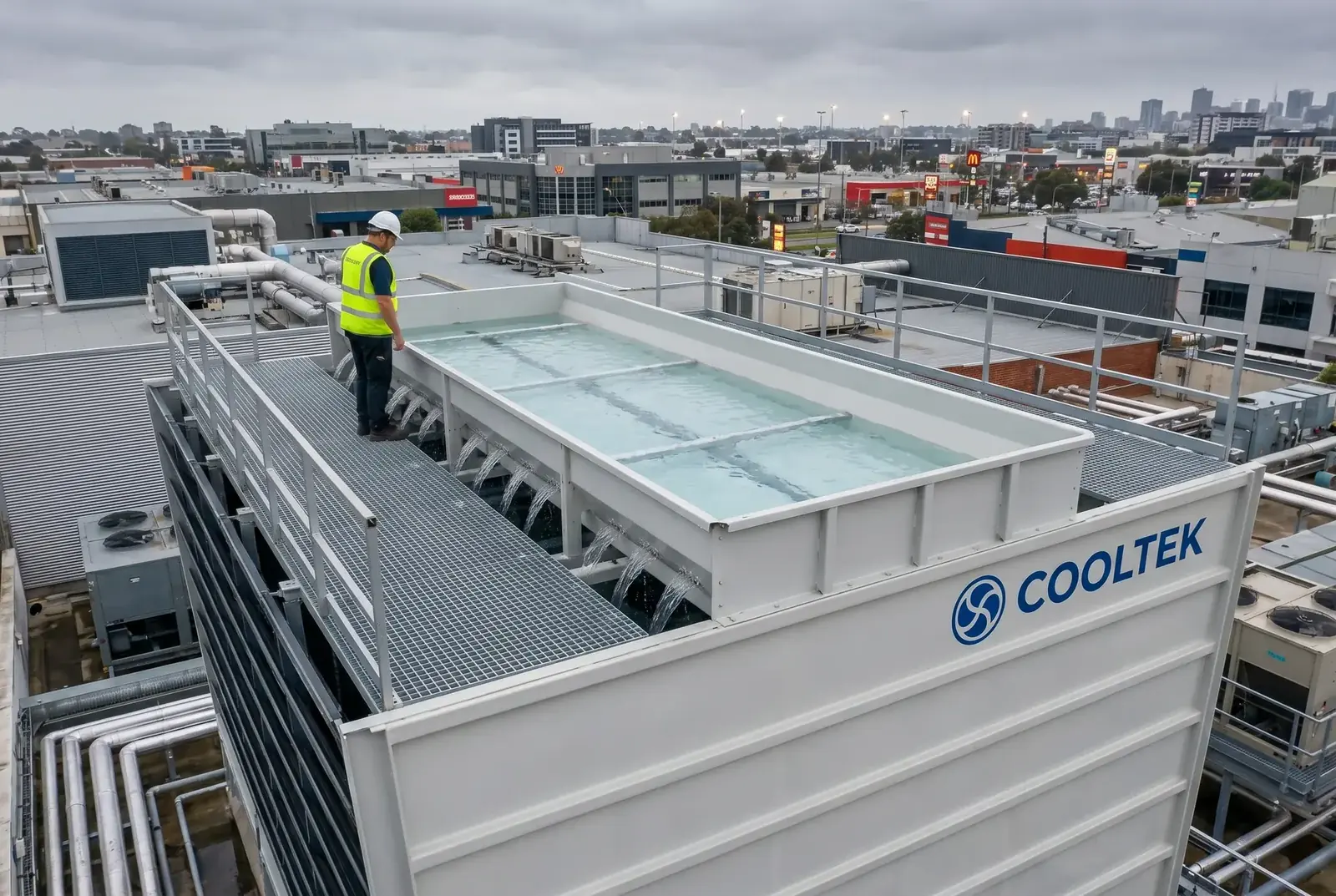
The LHR crossflow tower's low noise and low vibration characteristics make it the standard choice for commercial building applications in Vietnam's urban environment.
Reference standards: QCVN 26:2025 National Technical Regulation on Noise; ISO 1996-2:2017 Acoustics — Description, measurement and assessment of environmental noise; ASHRAE 2019 HVAC Applications Chapter 48 (cooling towers); CTI ATC-128 cooling tower sound measurement.