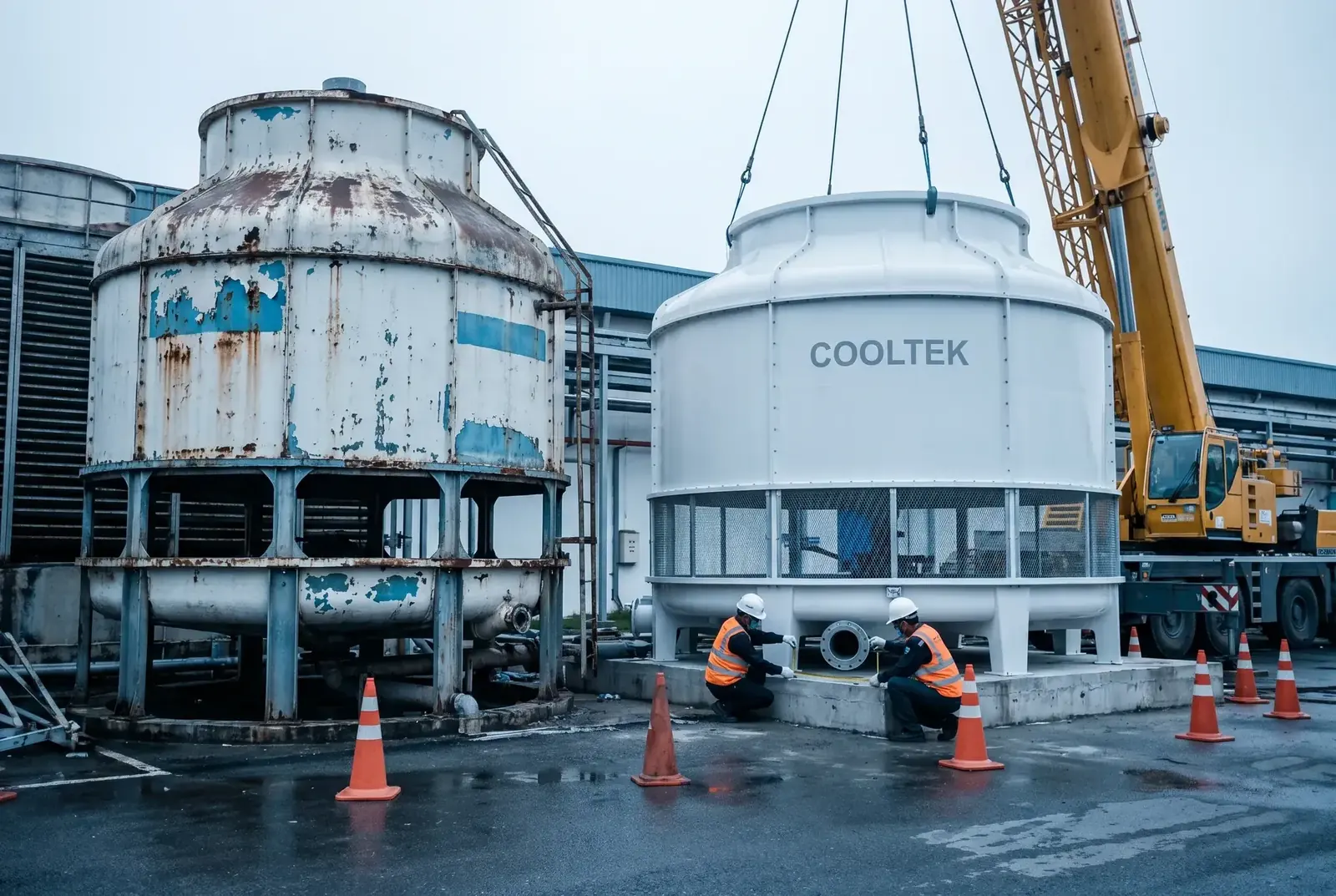
COOLTEK offers three main cooling tower series for industrial applications: the LH (round replacement), LHR (ultra-low noise crossflow), and LHN (compact square counterflow). All three series use FRP housing and are designed for Vietnam's industrial environment, but they target different application scenarios.
This article provides a four-question decision framework to identify the optimal series for your specific requirements.
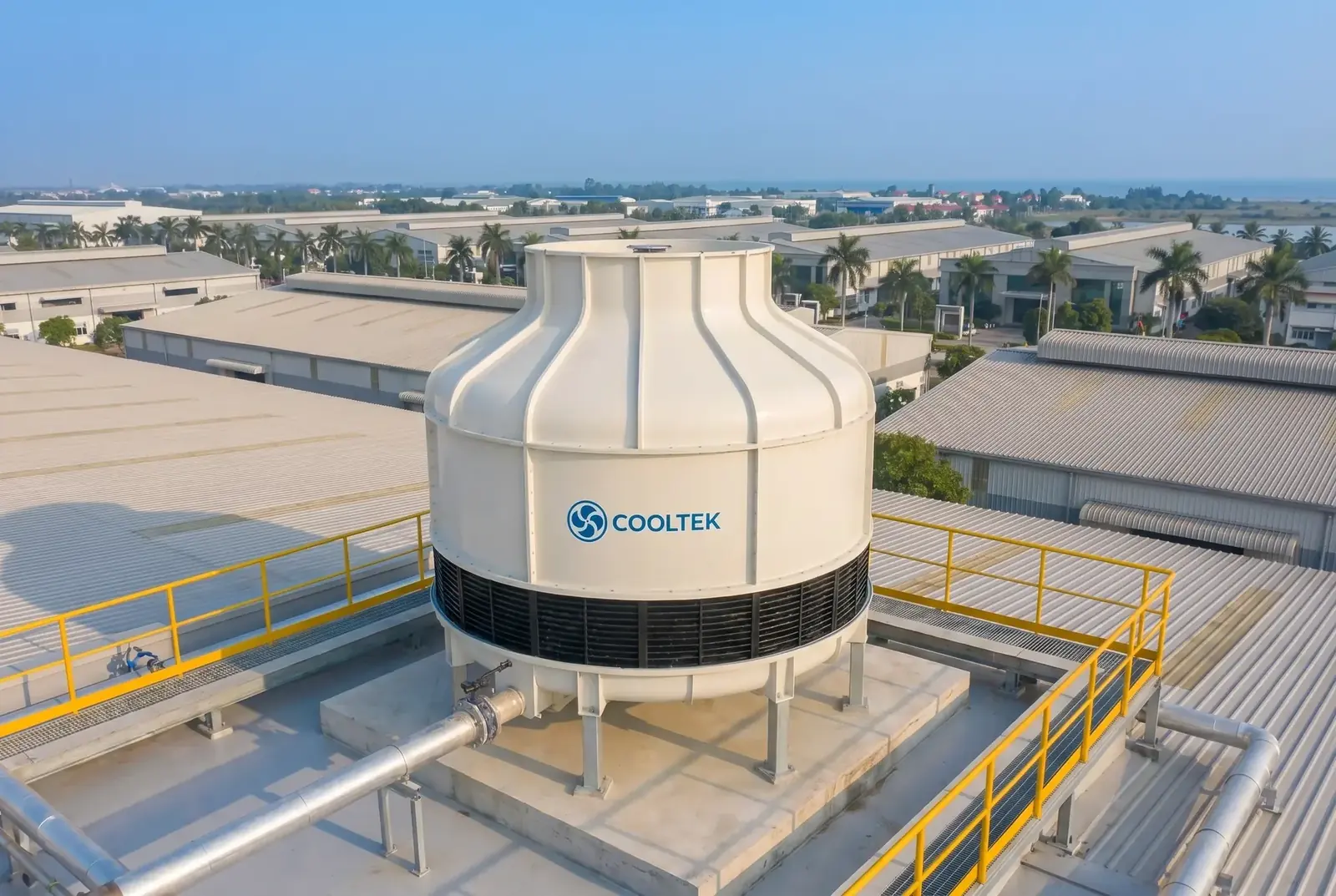
The LH, LHR, and LHN series each target a distinct application scenario. Answering four questions about your installation constraints and requirements will identify the optimal series.
Question 1: Are You Replacing an Existing Round Tower?
If yes → LH series is the primary candidate
The LH series is specifically designed for in-place replacement of standard round cooling towers. Its P.C.D. and flange positions match standard round tower dimensions, allowing direct replacement without modifying piping or foundations. If your priority is minimizing replacement downtime and civil engineering cost, the LH series is the most economical choice.
If no (new installation or replacing a non-round tower) → proceed to Question 2.
Question 2: Is Noise a Critical Constraint?
If yes (noise limit <65 dB(A) at property boundary, or installation near residential/hospital/school) → LHR series is required
The LHR crossflow series achieves 52–62 dB(A) at 1 m, which is 10–16 dB(A) quieter than equivalent-capacity counterflow towers. This makes it the only COOLTEK series that can reliably meet QCVN 26:2010 residential zone noise limits (<55 dB(A) daytime) without additional noise attenuation enclosures.
If noise is not a critical constraint → proceed to Question 3.
Question 3: Is the Installation Footprint Constrained?
The three series have different plan area to capacity ratios:
| Series | Configuration | Plan Area (relative) | Height (relative) |
|---|---|---|---|
| LH | Round counterflow | 1.0× (circular) | 1.0× |
| LHN | Square counterflow | 0.8× (square, stackable) | 1.0× |
| LHR | Crossflow | 1.3–1.5× (wider) | 1.2–1.4× |
If the installation footprint is tightly constrained and height is not limited → LHN series offers the most compact plan area, and multiple units can be arranged in a row for larger capacities.
If footprint is not constrained → proceed to Question 4.
Question 4: Is Pump Energy Cost a Priority?
If yes (large system >200 m³/h, high annual operating hours, or high EVN tariff exposure) → LHR series provides the best energy economics
The LHR crossflow tower's gravity distribution basin eliminates nozzle pressure, reducing water-side pressure drop by 30–60 kPa compared to counterflow towers. For large systems, this translates to significant annual pump energy savings (see the pressure drop savings article for detailed calculations).
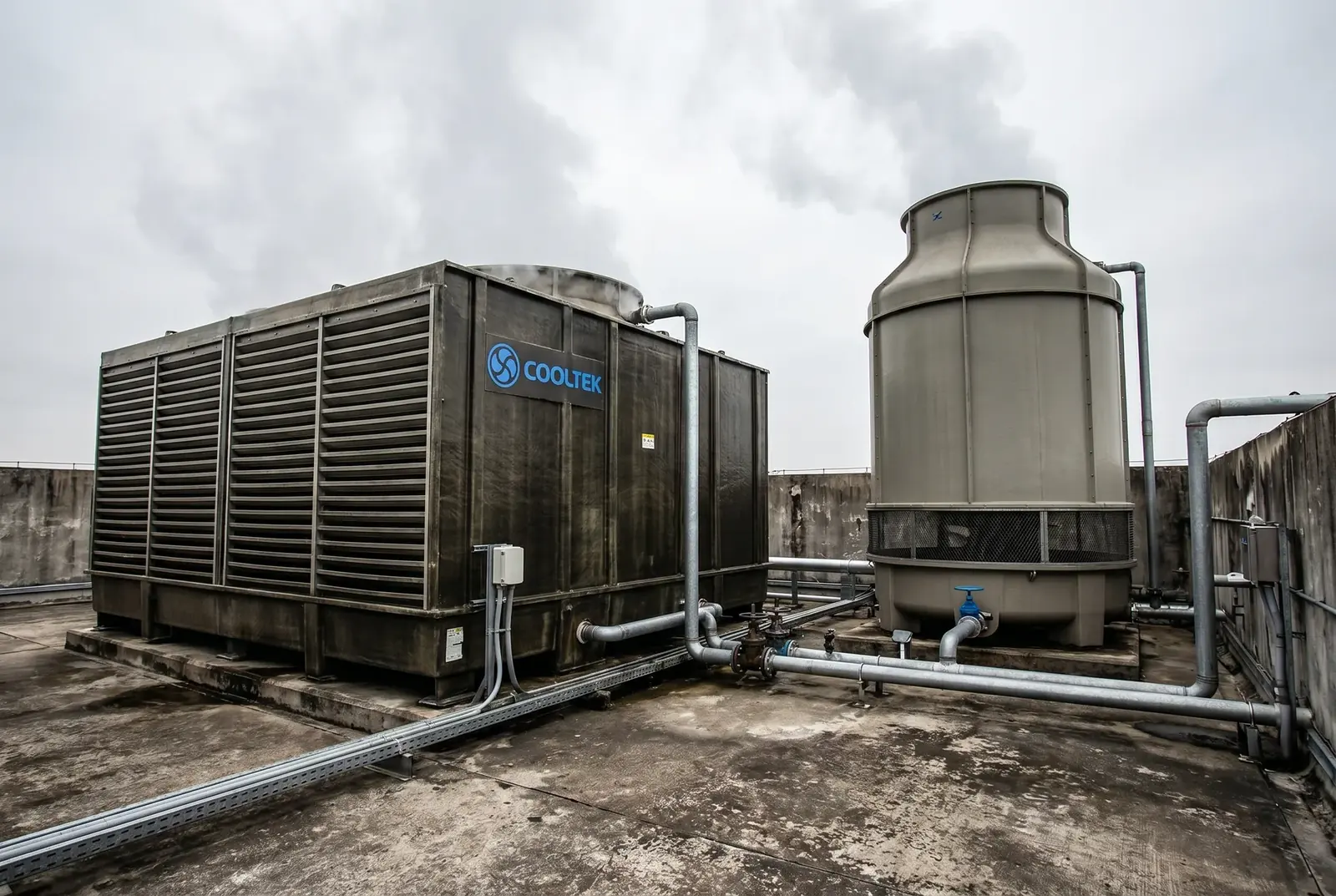
The LHR crossflow configuration provides the best combination of noise performance and energy efficiency for new installations without footprint constraints.
Summary Decision Matrix
| Scenario | Recommended Series | Key Reason |
|---|---|---|
| Replacing existing round tower | LH | Direct in-place replacement, no piping modification |
| Noise-sensitive location | LHR | 52–62 dB(A), meets residential zone limits |
| Constrained footprint, multiple units | LHN | Compact square, stackable arrangement |
| Large system, energy cost priority | LHR | 30–60 kPa lower pressure drop |
| 24/7 production, online maintenance | LHR | Open gravity basin, no shutdown required |
| Budget-constrained new installation | LH | Lowest initial cost in the COOLTEK range |
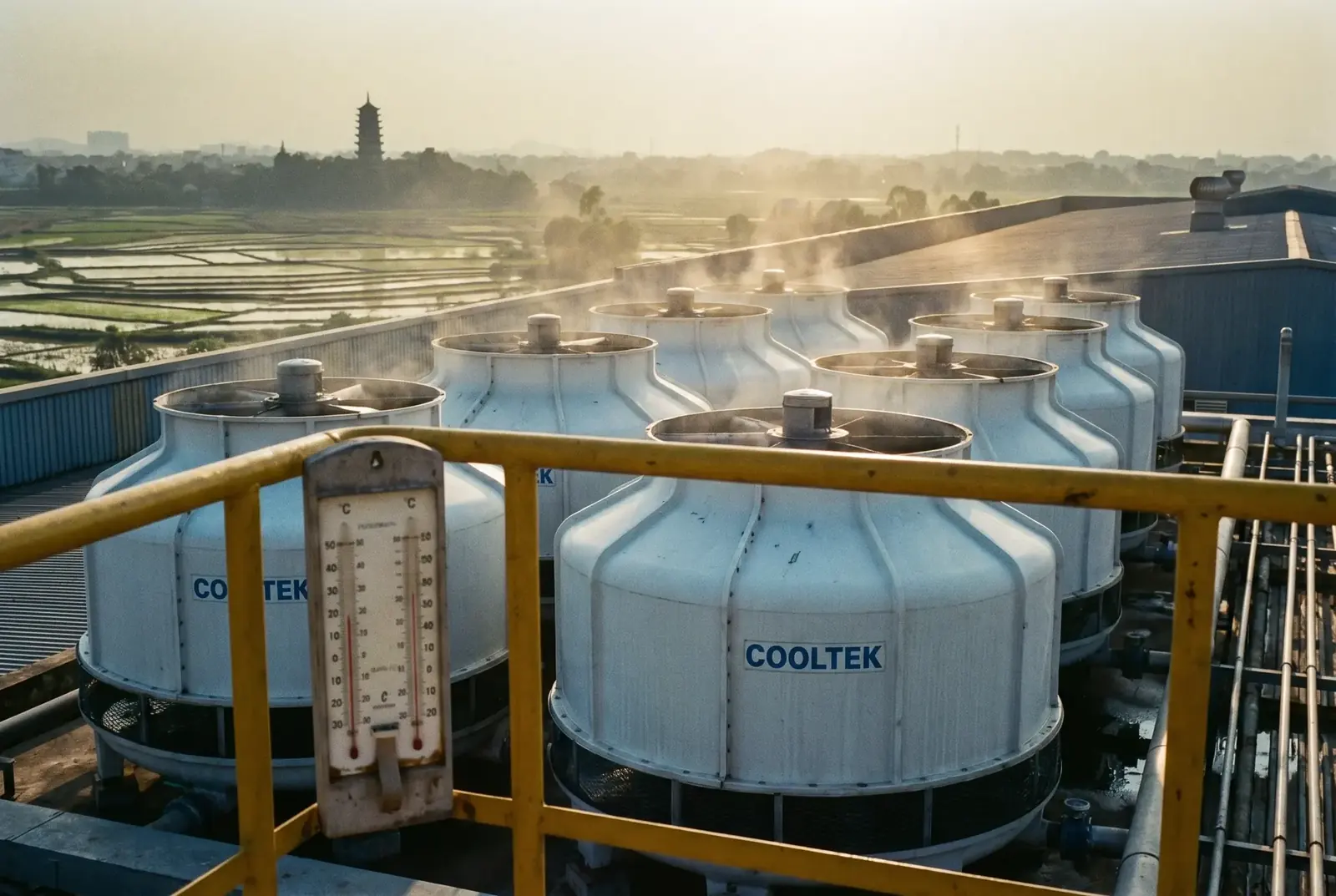
Wet-bulb temperature is the fundamental thermodynamic limit for cooling tower performance. All three series are rated at the same design wet-bulb conditions for Vietnam's industrial zones.
Reference standards: CTI ATC-105 cooling tower performance test code; QCVN 26:2010 National Technical Regulation on Noise; ASHRAE 2019 HVAC Systems and Equipment Chapter 40.