For food, beverage, pharmaceutical, and precision electronics manufacturers, the cooling system is the "lifeline" of the production line. Any unplanned shutdown means direct production loss and quality risk. However, the enclosed nozzle system of a traditional counterflow cooling tower requires periodic shutdown for cleaning — creating a fundamental conflict with the needs of continuous 24/7 production.
Starting from the physical structure of the cooling tower water distribution system, this article explains why the open gravity distribution basin at the top of the LHR crossflow tower can achieve true "online maintenance" and provides a maintenance planning framework for high-continuity production environments.
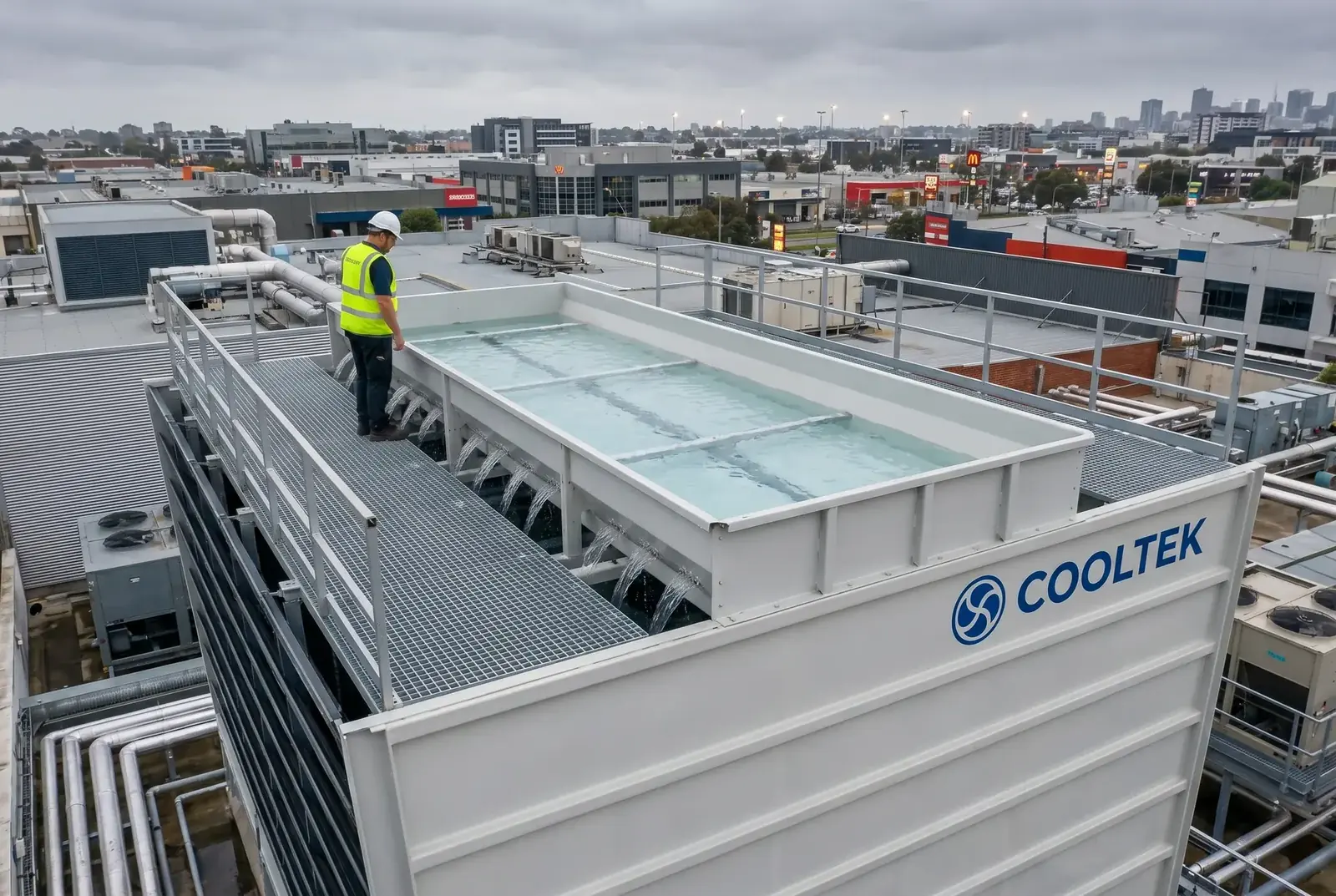
The open gravity distribution basin at the top of the LHR crossflow tower allows maintenance personnel to enter the basin area directly for cleaning and inspection while the equipment is still operating.
1. Structural Challenges in Maintaining Counterflow Towers
1.1 Maintenance Constraints of an Enclosed Nozzle System
The water distribution system of a traditional counterflow cooling tower — including round towers and square counterflow towers — consists of enclosed piping and nozzles. During operation, this design requires a certain water pressure, usually 30–50 kPa, to keep the nozzles working properly. When the nozzles need cleaning, the following steps are required:
- Stop the circulating water pump and depressurize the system.
- Open the inspection access and enter the tower.
- Remove, clean, and reinstall the nozzles one by one.
- Restart the system and check whether the water distribution is uniform.
The entire process usually takes 4–8 hours, during which the cooling system is completely out of service. For a 24/7 production line, this means a "cooling tower maintenance shutdown window" must be reserved in the production plan, or maintenance must be delayed during the hot season at the risk of reduced cooling capacity.
1.2 Cumulative Effects of Nozzle Blockage
In Vietnam's industrial environment, suspended particles in cooling water — including dust, scale, and biofilm — gradually block the small nozzle openings, which are typically 8–15 mm in diameter. When the blockage rate reaches 20%, uneven water distribution causes partial drying of the fill and reduces cooling efficiency by 10–15%. If maintenance is postponed because the plant does not want to stop production, nozzle blockage accelerates further, creating a negative cycle.
2. The Online Maintenance Mechanism of the LHR Crossflow Tower
2.1 Physical Structure of the Open Gravity Distribution Basin
The LHR crossflow tower uses an open gravity distribution basin at the top of the tower instead of an enclosed nozzle system. Cooling water flows evenly into the basin by gravity, then falls naturally through evenly distributed openings at the bottom of the basin and is distributed across the surface of the fill.
The key advantage of this design is that the basin works under atmospheric pressure, so cleaning and inspection can be performed without stopping the pump. While the tower is operating, maintenance personnel can:
- Directly observe water distribution uniformity through visual inspection.
- Use a high-pressure water gun to clean the inner wall and openings of the basin without removing any components.
- Take water samples for water quality testing, including Legionella, pH, and turbidity.
- Remove sediment and biofilm inside the basin.
2.2 Section-by-Section Fill Replacement Without Shutdown
The modular fill design of the LHR crossflow tower allows section-by-section replacement. For a standard model with four fill sections, one section can be replaced at a time while the other three continue operating normally:
| Replacement Method | Shutdown Time | Cooling Capacity Loss | Applicable Scenario |
|---|---|---|---|
| Full shutdown replacement (counterflow tower) | 1–3 days | 100% | During planned production suspension |
| LHR sectional replacement (1/4 section) | 0 (no shutdown) | Approx. 25% (temporary) | During production operation |
| LHR sectional replacement (1/2 section) | 0 (no shutdown) | Approx. 50% (temporary) | During a low-load season |
3. Maintenance Compliance Requirements in Food and Pharmaceutical Industries
3.1 Legionella Control
According to the WHO Legionella control guidance (2007) and relevant regulations of the Ministry of Health in Vietnam, cooling tower water systems require regular Legionella testing and control treatment. The open basin design of the LHR crossflow tower offers the following advantages:
- There are no dead corners inside the basin, making biofilm less likely to accumulate.
- Sampling points are easy to access, making testing operations simpler.
- Cleaning and disinfection can be performed without shutdown by adding disinfectant directly into the basin.
3.2 Recommended Maintenance Frequency
| Maintenance Item | Frequency | Shutdown Required | LHR Operation Method |
|---|---|---|---|
| Visual basin inspection | Weekly | No | Direct visual inspection |
| Water quality testing (pH, turbidity, TDS) | Weekly | No | Direct sampling |
| Basin cleaning | Monthly | No | High-pressure cleaning during operation |
| Legionella testing | Quarterly | No | Direct sampling for laboratory testing |
| Fill inspection | Quarterly | No (sectional) | Sectional inspection without affecting overall operation |
| Fan blade inspection | Every six months | Short shutdown required | Stop for 1–2 hours |
| Fill replacement | Every 8–12 years | No (sectional) | Sectional replacement, 1/4 area each time |
Reference standards: WHO Legionella and the Prevention of Legionellosis (2007); ASHRAE Guideline 12-2020, Managing the Risk of Legionellosis; GB/T 50392-2016, Article 6.3, cooling tower maintenance requirements.